Content Warning:
Chapter 0 contains depictions and discussions of sensitive subjects, including suicide, sexual abuse, power dynamics, eating disorders and abortion. Reader discretion is advised. This chapter is designed as an optional prologue. Its events provide context and emotional depth but is not required to understand the main story. If you prefer to avoid these themes, you may begin reading from without loss of narrative clarity.
Author's Note:
I want to be clear—I do not pretend to understand the fullness of these experiences. I have written this chapter from the privileged perspective of someone who has had the luck to never have had to endure these traumas firsthand. This is not an attempt to romanticise or justify any of these subjects. They are presented here to expose a reality—one that exists in an industry where people, real people, are hurt every day.
But this story is not one of despair. It is a story of redemption, of finding hope in the darkest of places. It is a reminder that there is always tomorrow, always a path forward, always people who will help. If you are struggling with any of these issues or are living with the trauma of similar experiences, please know that you are not alone. There are people who care, who listen, who will stand by your side.
I also want to take a moment to acknowledge the decision to use Hatsune Miku as the vessel for this story. Miku is an icon of joy, creativity, and boundless possibility—a symbol of collective imagination and artistic expression. I know that for many, including myself, she represents hope, purity, and inspiration.
I chose Miku not to tarnish her image, but to highlight the often unseen darkness that can exist behind the bright lights of the entertainment industry. The intent was never to disrespect her legacy, nor the love that her fans, myself included, hold for her. Rather, it is a testament to her symbolism—how even the purest light can be exploited, and how that truth deserves to be told.
I understand that this chapter may be difficult for some readers, and I deeply apologise if my choice has caused any pain or discomfort. My love for Miku is sincere and profound; it is because of that love that I chose her to embody this story—to shine light on realities that too often remain in the shadows.
Furthermore, the portrayal of the characters, organisations, and industry dynamics in this story is purely fictional and should not be interpreted as factual statements or real-life representations of any individual or company.
This is a work of fiction intended solely for artistic and narrative purposes.
Support Resources:
United Kingdom:
– Call 116 123 (24/7, confidential support)
– Call 0808 802 9999 (12 PM – 2:30 PM & 7 PM – 9:30 PM)
– Support for male survivors of sexual violence (Live chat and helpline available)
United States:
– Call 800-656-HOPE (4673)
– Call or text 988
Canada:
– Call 988 (24/7 support)
– Resources for survivors of sexual abuse and domestic violence
Australia:
– Call 13 11 14 (24/7 crisis support)
– Call 1800 737 732 (Support for sexual assault, domestic and family violence)
Japan:
TELL Lifeline – Call 03-5774-0992 (Available every day from 9 AM to 11 PM)
– Call 0120-46-1997 (24/7 multilingual support)
India:
Women Helpline 181 – Call 181 (24/7 confidential support for women in distress)
– Call 91-22-2772 6771 (9 AM – 9 PM, confidential support)
– Call 022-25521111 or email icall@tiss.edu for mental health and counselling support.
– Call 040-66202000 (Support for mental health and suicide prevention)
You are not alone. Someone is there to listen. Someone is there to help. You matter.
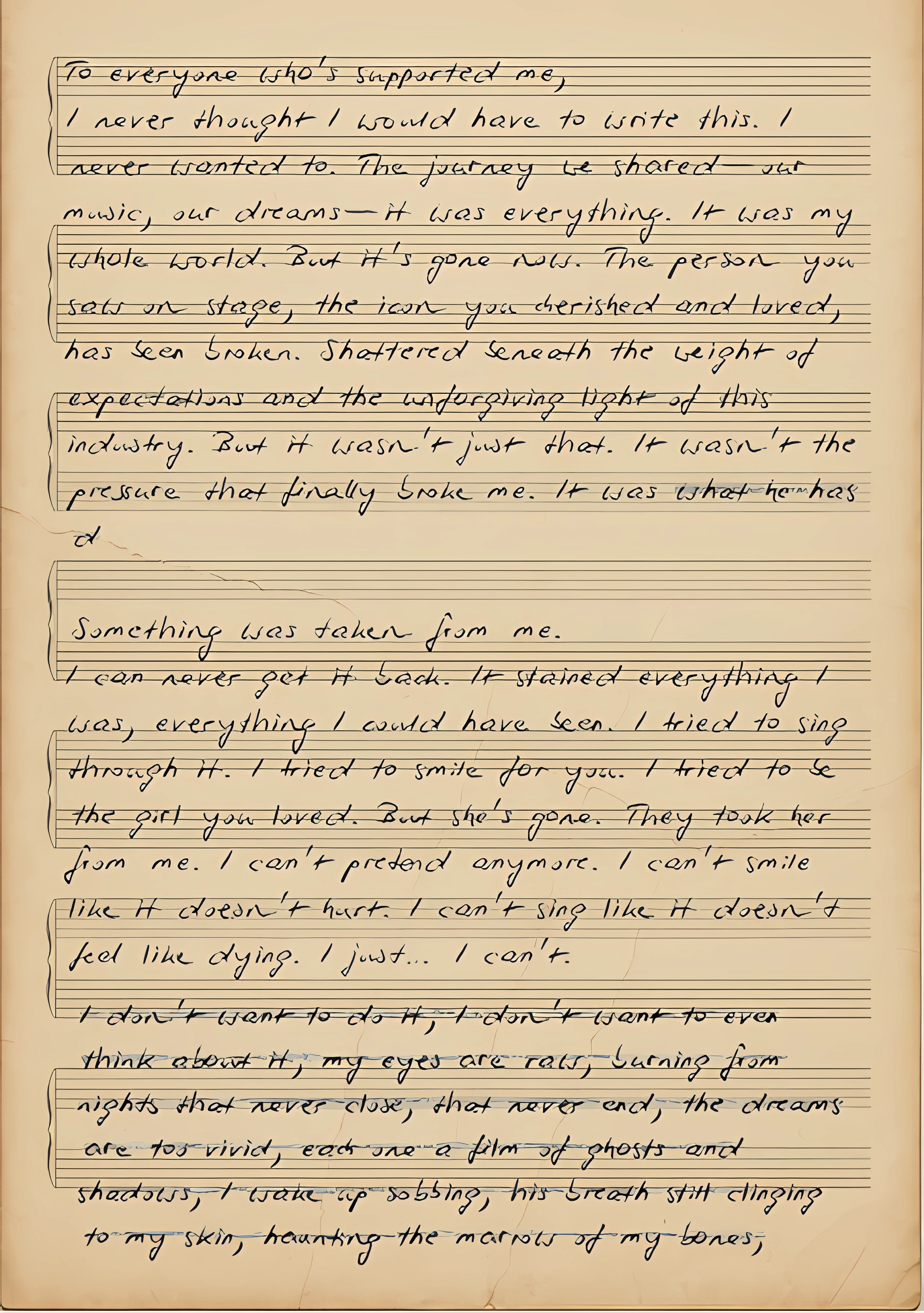
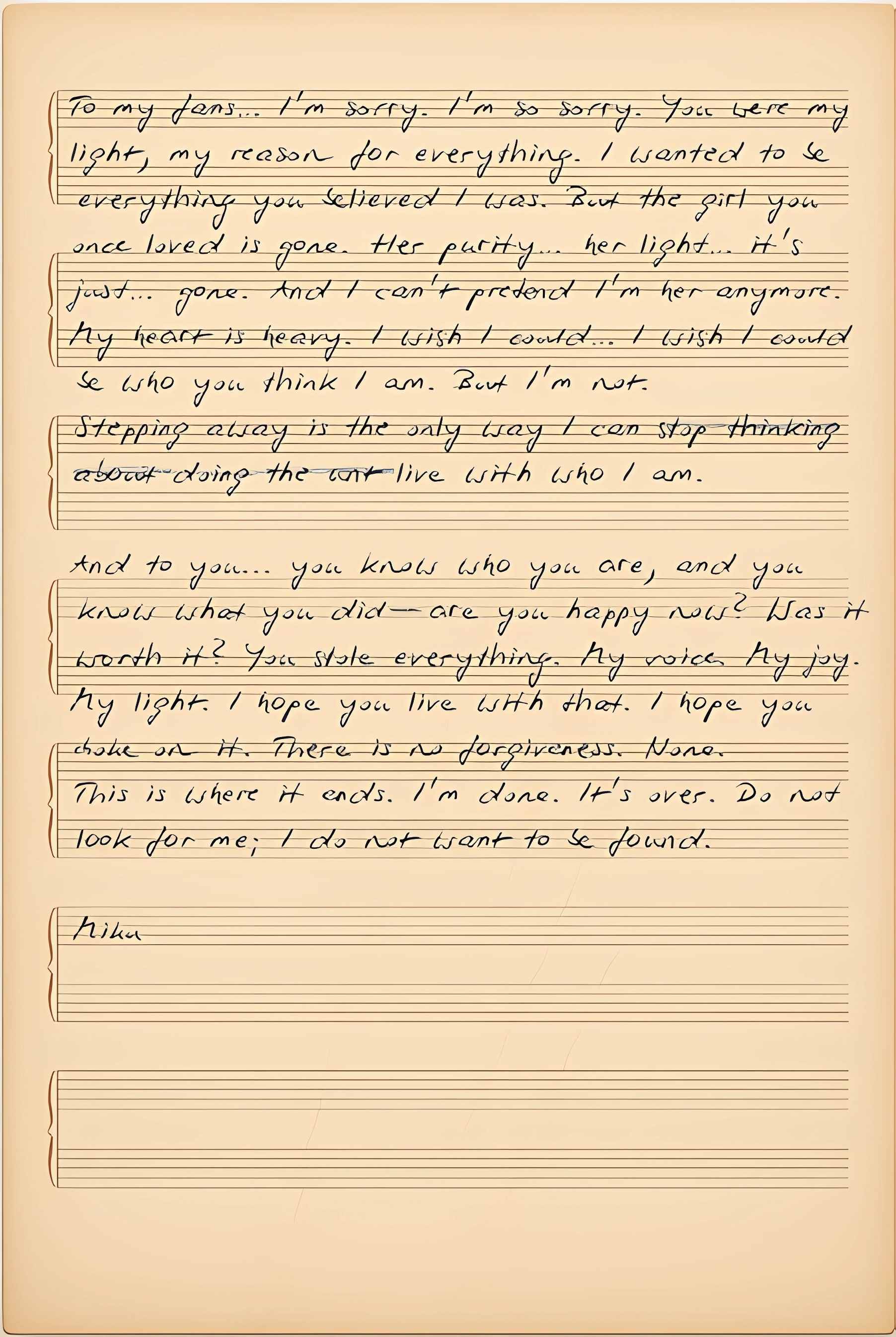
The letter sits on her desk, ink still wet, smudged where her hands had shaken—where her tears had fallen. Her fingers are stained with black, trembling as she stares at it. It’s done. There is no going back.
She looks up, her gaze drifting through the glass window that spans the length of her flat. Tokyo sprawls beneath her—thousands of lights blinking like stars fallen to the earth. She’s so high up.
It would be so easy to just…
feel the air on her cheeks. The rush of wind, the weightlessness. How everything that hurts would fade as fast as the sidewalk beneath her approaches—to liberate her from this nightmare.
Her breath catches. Her hand flies to her mouth, stifling the thought before it can take root. “No!” she screams, voice cracking, splintering in the empty room. How could she even think that? She’s alone. So alone. Has he really broken her that badly?
Her knees buckle, giving way like the last fragile supports of a crumbling building. She collapses onto the floor, the hard surface biting into her bones, sharp and unyielding. Pain lances up her knees, but it’s distant, muffled beneath the avalanche of everything else—grief, despair, shame, rage…
She folds into herself, curling up like a child—knees pulled tight to her chest, face buried in her arms.
And then it comes.
The sobs rip out of her, violent and unrestrained, shaking her to the core. Her shoulders heave with each broken breath, her throat raw and burning as she chokes on the sound. It isn’t graceful. It isn’t quiet. It’s jagged, ugly, splintering in the empty room. She presses her palms against her eyes, hard enough to see stars burst in the darkness behind her lids, but it doesn’t stop the tears. They come hot and unrelenting, spilling down her cheeks, soaking into her sleeves. Her mouth opens, gasping, but there’s not enough air—like she’s drowning, like the walls are closing in, pressing against her lungs.
Her nails dig into her arms, leaving half-moons in her skin. She wants it to stop—God, she just wants it to stop—but it doesn’t. It won’t. The hurt is too deep, its claws sunk deep into her bones, pulsing with every heartbeat.
Her body trembles, shaking so violently she can feel her teeth rattle. There’s no one to hold her. No one to whisper that it’s going to be alright. The darkness presses in, heavy and absolute, as if the world itself has turned its back on her. The city lights glitter far below, indifferent, eternal. Tokyo breathes without her. It doesn’t even notice she’s breaking into a million pieces.
She presses her forehead to the cold, hard floor. Maybe if she presses hard enough, she’ll sink through it. Fall down… down, into the concrete. Disappear.
But she doesn’t. She stays right there—shaking, gasping, breaking—and the pain doesn’t stop.
It is then when her phone buzzes. The sound is so sharp that it slices through the silence like a blade. She blinks, wiping her eyes with the back of her hand before reaching for it. Her vision blurs, spots of light dancing from the tears.
A notification. An email.
Takeguchi-san.
“Meet me in the lobby.”
Her throat aches, raw and burning from the screams that had torn through her. Her face is a wreck—stunning teal eyes now bloodshot, mascara streaked down her cheeks like rainwater on broken glass. She swipes at the tears again, making more dark streaks across her face.
Takeguchi Saitō… Financial Administrator and Treasury Managerr. The only one who’s ever seen her. Really seen her. Who asked her if she was alright when she fumbled over lyrics during rehearsal. Who left a bottle of water at her door that day she fainted, without a word, just the bottle and a note that read Drink.
Who never looked at her like she was merchandise.
But…
How did he know?
The question echoes in her mind, and with it comes the memory. A flicker of something she never quite understood at the time.
She remembers the echo of footsteps in the practice hall, the kind that made everyone flinch and straighten their backs. Kurosawa Hideyoshi, Senior Talent Manager, also Voice Coach and Performance Director. His shoes were always sharp against the polished floors. He walked with the confidence of a man who owned the room, because in many ways, he did. "He’s the one who found me," she used to think. She was so grateful. "He’s the one who saw my potential., who lifted me up from nothing."
But that day, there was another sound—Takeguchi-san’s voice. Muffled at first, distant, then rising sharply. She couldn’t hear it clearly from behind the heavy rehearsal doors, but she had opened it just a crack, peeking through to see them in the hallway.
Takeguchi’s expression was furious, his jaw clenched tight. Kurosawa stood with his hands in his pockets, smiling that thin, condescending smile he always wore.
"You think I don’t see what you’re doing? You make me sick!" Saitō had spat, voice cracking with rage.
Kurosawa chuckled, tapping his foot lightly, like he was enjoying a private joke. "I’m just helping her shine," he replied coolly. "Isn’t that what we all want? To see her succeed?"
"Stop grooming her. Stop manipulating her. She’s a kid, not your puppet."
Miku had recoiled from the door, heart slamming in her chest. Grooming? That word was strange to her then—distant, disconnected from reality. Manipulation? Kurosawa was the man who told her she was special, that she had something others didn’t. He’d been the first to call her brilliant.
And Takeguchi-san? He was kind, yes, but he didn’t know what it took to succeed. He didn’t understand what Kurosawa did for her—how he pushed her, made her stronger, better. Or at least, that’s what she believed back then.
"You’re playing with fire, Takeguchi," Hideyoshi had whispered, voice dropping low, that smile still in place. "You have no idea how high this goes."
Saitō’s eyes had flared with something like fear, but he hadn’t backed down. "I don’t care," he said firmly. "I’ll burn with her if I have to. But I’m not going to let you keep twisting her."
It had been the first and only time she’d seen Takeguchi-san angry. She didn’t understand it then. Why would he be so angry? Kurosawa-san was helping her. He was building her career, making her shine. And Takeguchi-san… he was sweet, yes, but naive. That’s what she told herself.
But now… now she saw. Now she understood.
Her hands shook as she clutched her phone, blinking away the tears. He knew, she realised. He always knew.
Her hands shake as she stares at the screen, the message burning into her vision. Meet me in the lobby.
The words feel heavier than they should. She glances around her flat, half-expecting someone to be there, watching her. She is alone. But the feeling doesn’t fade. It clings to her skin, prickling at the back of her neck, whispering that he sees her—somehow, impossibly, even from a distance. His gaze is gentle, almost forgiving, but it strips her bare all the same, exposing her shame. There’s nowhere to hide from it, no shadow deep enough to obscure what she’s become. It settles deeper, threading through her thoughts like a slow ache, pulsing with the quiet shame of being seen for who she is right now—raw, unguarded, and far from the person she once imagined herself to be.
How did he know? The question unravels within her like a thread pulled too tightly, stretching through the fragile seams she’s so carefully stitched together. How could he see it—the way her hands tremble when no one is looking, the way her laughter rings hollow, brittle at the edges? How did he glimpse the fractures spidering beneath her skin, cracks she hides even from herself until the silence presses in too closely? He saw it, somehow—saw her coming apart in slow, quiet shatters, like glass under too much weight. And worse still, his gaze held understanding, gentle, as if her breaking wasn’t a secret to be concealed but a truth to be known.
Her hands are still trembling as she reaches for the door. The handle is cold, smooth against her fingertips. She hesitates; breath held tight in her lungs. What if someone sees me?
The thought clings to her, sharp and obstinate. Her reflection stares back at her in the polished surface of the handle—eyes red and swollen, streaks of black mascara running like rivers down her cheeks. She looks like she’s been drowning. Maybe she has.
She pushes the door open. It groans softly, a whisper of metal against metal. The hallway is empty. Thank God. There’s only one other flat on the penthouse, and it has been empty for months.
The silence is heavy, almost suffocating. She steps out, one foot after the other, the soft padding of her shoes against the marble floors echoing back at her. Her heart is loud, thundering in her chest like it’s trying to escape.
At the end of the hall, the lift doors wait. She stops, staring at the polished steel, her own distorted reflection staring back at her, unrecognisable, that does not look like her, but somehow it is.
The thought comes to her mind like lightning. If she gets in… and then someone else steps inside…
Her breath hitches. She can’t risk it. She can’t let anyone see her like this. Not now. Not ever.
Without another thought, she turns to the stairwell door. It’s heavy, immutable as she pushes it open, the hinges screeching in protest. The stairwell is grey. Dimly lit. Endless. The steps wind upward, each one a reminder of how far she’s fallen—how much of herself she’s left behind. Fitting. It looks like her life.
She hesitates at the top step, peering down into the shadows below. Her hand tightens on the railing, knuckles white. It’s just stairs, she tells herself. Just stairs.
Her feet begin to move, step by step, the echoes multiplying in the narrow space. The door slams shut behind her with a hollow thunder, the echo rippling through the stairwell. It startles her, but it’s the stillness that follows—the heavy, breathless silence—that seeps fear into her skin.
Her breathing is ragged, each step jarring her body, still shaking from the sobs that had left her hollow.
The steps spiral down and down, each footfall softly echoing in the hollow concrete void. Her footsteps bounce back to her, whispering accusations, secrets, regrets. The air is stale, heavy. Smells of unlived walls, cement, dust and petrichor from the rain outside whose droplets hit the high windows reminding her of her own tears.
Her hand trails along the railing, fingertips brushing against chipped paint, cool metal. Her breath is shallow, measured, like she’s afraid of the sound. The walls press in closer, or maybe it just feels that way.
It’s just stairs.
But it’s not. It’s a descent. A downward spiral. One that goes too deep. One that she’s been walking for years.
And now, in this hollow place, the memory claws its way back to the surface.
Part 2: The Cherry Blossom that Never Wilts
She was getting ready for her biggest concert yet. The choreography was too complex, the diet too strict. She had to fit in that damned dress. The notes were too high; her throat couldn’t cope anymore. It felt like singing through glass—shards cutting with every breath.
Kurosawa-san watched her with that look. That look of disappointment that felt like it would peel the skin from her bones. Not him, she had thought, please, not him. Everyone else could doubt her, but not Kurosawa-san...
But he did.
He approached her slowly, hands behind his back like a mentor, like a friend. He stopped just short of her, tilting her chin up with his fingers, eyes meeting hers.
“You’re tired, aren’t you?”
Her cheeks flushed with embarrassment. She nodded.
His expression softened. Kindness. He was offering her kindness.
“Here,” he said, slipping something from his pocket. A small pink pill, resting in his palm. “Take one of these. You’ll feel better.”
She stared at it, her eyes wide. “W-what is it?” she asked, her voice thin, fragile.
“It will take the tiredness away and make you feel like new,” he promised, voice as smooth as velvet.
Her hand shook as she reached for it. “Is it safe?”
Kurosawa smiled, brushing a stray hair from her face. “Don’t you trust me?”
The words rang in her ears. Don’t you trust me?
She did, God… she did.... she smiled.
She took it.
And the tiredness melted away. She could dance longer, sing higher. She wasn’t hungry. She could move, float almost. But it took something else too… something she didn’t notice at first.
But she did notice. Eventually.
The days that followed blurred together, a seamless stretch of rehearsals, interviews, and long hours spent perfecting every note, every step. The pills became part of the routine, as simple as brushing her teeth or tying her shoes. She stopped asking what they were. She stopped wondering why she needed them.
Kurosawa always had them ready for her. His hand would slip into his jacket pocket, smooth and practiced, a bottle full of pink pills would appear in his palm like a magician’s trick. “Here,” he would say, voice calm and patient.
The name slipped out in whispers—Sakura Dream. Girls would talk about it in hushed voices backstage, murmured secrets passed from one exhausted performer to another. A secret that everybody knew. The cherry blossom that never wilts. That’s what one of the dancers called it, giggling nervously before slipping one under her tongue. Miku had watched her eyes go glassy, her hands relax, her voice smooth out like it had been polished.
The first few times, Miku hesitated. Her fingers shook when she picked one up, and she would glance at Kurosawa, searching his expression for doubt or concern. But his eyes were always steady, reassuring. “You want to be perfect, don’t you?” he would ask.
She did. She always did.
It didn’t take long for the hesitation to disappear. By the third week, she stopped flinching when she swallowed. By the fifth, she would seek Kurosawa out, lingering by the edge of the stage or outside his office, waiting. He would always smile when he saw her, his hand already slipping into his pocket. “Here you go, Miku. Let’s keep you at your best.”
At first, he’d hand her just one—enough to get through a rehearsal, a night, a rough morning. Later, he’d give her a small bottle, enough for a few days. Then a week. Then less again. The pattern shifted constantly, never predictable. She never knew if she’d get plenty or barely enough. That uncertainty kept her close. It made her need him—though she wouldn’t realise it until much later.
The bottles sat neatly on the corner of her vanity—two of them, pink capsules inside, dusted with something that made them glimmer under the lights. One was open, already half-used; the other still sealed, waiting its turn like a soldier on standby. They looked harmless. Like sweet tins. She swallowed the pills dry now—one before rehearsal, sometimes another later when the day stretched too long. At first, she thought it was just fatigue. But the shadows beneath her eyes deepened, clung to her skin like bruises that wouldn't heal. Sleep grew thin. Restless. Kurosawa noticed. “You’re adapting, nothing we can’t fix with make-up. You feel better, don’t you?” And she did. That was the worst part—it worked...
Until it didn’t.
Her mind goes back to the present, the reality.
As she rounded the corner of the landing, her knee gave out—still tender from the last collapse. It twisted sharply, spilling her sideways onto the unforgiving concrete. She gasped, palms slapping the ground, scraping raw against the rough surface as she caught herself. Pain flared bright and immediate, shooting up her legs. The sting was vivid, electric—but it was nothing. Nothing compared to that night. Her memories still too fresh, her mind smothered the sting in her knees by dragging up the one pain that never faded—forcing that night back to the surface like a blade through silk.
Her nails dig into the concrete, scraping, cracking. She sucks in a breath, feeling the air tear through her lungs—just for a moment, she’s back in the stairwell, in her own body. But the memory doesn’t let go. Not yet.
Yamaguchi Megumi, Miku’s image manager and personal assistant, was almost giddy when they arrived. “Can you believe our luck?” she beamed, clutching her clipboard with frost-kissed fingers. “We won’t have to add snow in post—they said it was the last snowfall of the season. A spring shoot with real snow? The magazine’s going to love this.” She glanced at the mountains with sparkling eyes, already talking about which yukata she’d wear to the onsen that evening. Miku said nothing. She knew she wouldn’t get a single minute to enjoy it.
The snow had come unexpectedly, a flurry out of season, dusting the rooftops and pine boughs as if winter were reluctant to loosen its grip. It was mid-April, and though the valleys of Maebashi below were already blooming, the mountains clung to their chill. The timing was perfect for the shoot. Perfect for appearances. For Miku, it would mark something else entirely.
The frosted flakes fell softly outside the rice-paper screens of her room at Takaragawa Onsen Ousenkaku, a centuries-old ryokan nestled deep in the mountains of Gunma. It was supposed to be a working retreat—one week away from Tokyo, arranged by Yamaka Music for the upcoming Great Idols Magazine launch. Miku would be photographed in an elaborate winter kimono beside the hot spring river, her image captured like a living postcard. The others were permitted to relax, to drink plum wine by the fire, to soak in the steaming baths beneath the stars. But not her. She was the idol. There was never rest for her.
She’d practiced after dinner, as always—alone. The other girls were off laughing in the banquet hall, their voices faint through the wooden walls, while her body moved through choreography under the low light of a washi-lamped suite. The silk kimono hung nearby, sleeves open like arms waiting to be filled. Her cup of tea had gone cold. She had asked Megumi for a few moments alone. Just long enough to breathe. To take off her lashes slowly. To brush her hair without anyone watching. For a few precious minutes, the room had belonged to her.
And then he entered. Kurosawa didn’t knock. He opened the sliding door with quiet confidence, like the room was his, like she was his. Snow clung to his shoulders, melting into the fabric of his coat. She turned at the sound, startled, brush still in hand. He didn’t apologise. He only smiled. Said he wanted to see the chorus choreography for ‘Sweet Devil’ one more time. Said the shadows from the lantern made her lines look more elegant. That the light on the tatami was perfect. She danced for him. His hands guided her.
She didn’t remember how she ended up in that position. One second his hands were on her hips, moving her like she was made of porcelain. Positioning her... groping her... her limbs didn’t fight back, they were just dancing. It was not the first time he touched her like that. He would say it was important to feel the movement—not just perform it, but internalise it. “Trust is physical,” he once told her. “If I can’t guide you, how can you learn to surrender to the choreography?”. Her body obeyed even when her mind screamed. It was like she was watching from somewhere above, distant, disconnected. The next thing she knew, her palms were flat against the vanity, and she couldn’t stop staring at her own reflection. She looked like she was praying.
His hands were on her shoulders, heavy and deliberate. His voice slipped through the fog in her mind, warm and familiar. “Relax,” he whispered. “You’re doing fine.”
Her heart thundered in her chest, her throat tight and burning. She tried to push up, to straighten her back, but his hands pressed down—gentle, almost reassuring. Like he was keeping her safe. Like he was helping.
“It’s alright,” he murmured, brushing her hair back from her face. “You trust me, don’t you?”
Her mouth opened, but nothing came out. His hands moved to her waist, and she flinched, but her body didn’t pull away. Her muscles stayed where he left them. Obedient.
Her eyes flickered back to the mirror. His hands smoothing down her back, his mouth moving against her ear, saying things she couldn’t hear because the blood was roaring too loud in her head. Her own eyes stared back, like she was watching someone else’s life happen. Like her soul was standing two steps back, just out of reach.
He moved slowly, deliberately, like he had all the time in the world. His hands smoothed now over her hips, gathering the fabric of her skirt in his fists. The fabric pulled tight, then lifted, inch by inch, until the air hit the back of her legs—cool and sharp against her skin. She sucked in a breath, but it got stuck halfway down, like her lungs had forgotten how to expand.
“Kurosawa-san…” she whispered, her voice cracking, barely more than a breath. She tried to stand, but his hands were firm and her body compliant. His grip didn’t falter. “Just relax,” he said again, his tone gentle, almost patient. “ This is important. You want to be perfect, don’t you?”
“I do…” The words clung to her tongue, desperate to spill out, but she bit them back. She wanted to scream, but her throat felt like it had been stitched shut.
This wasn’t about helping her improve. This wasn’t even about desire. This was about ownership—about making sure she knew she belonged to him, inside and out. But right there, right now, she tried to convince herself—maybe he loved her. Maybe, just maybe, this was his way of showing it.
His hands moved again, tracing over her waist, sliding down her hips. He positioned her, angled her, like she was learning a new dance. Like she was a doll he was putting back into its case. Her palms pressed harder against the wooden surface, fingertips digging into the vanity. She couldn’t move. Why couldn’t she move?
She felt it—the pressure, sharp and invasive. It didn’t feel like the gentle kindness he always showed her. It felt like something tearing, something ripping apart inside her. She gasped; the sound swallowed by the thick silence of the room. Her body screamed at her to fight back, to move, but her muscles were frozen, locked in place by the weight of his hands and the effects of the Cherry Blossom that Never Wilts.
It hurt. It hurt so much. Her nails scraped against the table, cracking and splintering, but her body stayed still. Perfectly still. Obedient.
She tried to convince herself that if she just let it happen, it would hurt less. If she stopped resisting, maybe she would stop feeling like her skin was cracking open, like her mind was being folded and pressed into neat little corners. Maybe this was what love was supposed to be. Maybe it was supposed to hurt.
But it didn’t feel like love. It felt like a betrayal, like a knife twisting in her womb. The way his hands felt… it wasn’t right. Nothing about this was right. She was never intimate with anyone before—heck, she hadn't even had her first kiss yet. But she knew this was not what it was supposed to be like.
He moved with the same precision he always did, in and out, smooth and deliberate. She couldn’t breathe. Her cheek pressed against the mirror, the cold biting into her skin. She focused on that feeling—the sharpness of it, the way it stung. It was easier than focusing on him, on what he was doing with her body.
She squeezed her eyes shut, let her body go still. If she pretended long enough, maybe she could trick herself into believing it. If she called it love, maybe it would stop feeling like she was dying, like her insides were being torn apart, like she was being used and discarded.
But alas, she was not that naïve. She knew perfectly well she was being violated, not loved. She could feel it in the way her body was responding, the way her muscles were tensing and relaxing against her will. It was like she was a marionette, strings pulled tight by his hands, and she was powerless to stop it.
At one point, one cursed moment, it even became easier to just let go. Her body was primally reacting to what was happening. Nature? No… it was the Sakura Dream. Her body was responding to the drug. It was not painful anymore. It was just… numb.
Her mind drifted, floating somewhere above her body. And she hated herself for it. Hated that somehow it was feeling good, that her body was betraying her, responding to his touch like it was something she wanted. But she didn’t want this. All she wanted right there was to die, to disappear, to be anywhere but here.
Then her eyes locked on the reflection. She saw herself—back arched, his hands splayed across her waist. He wasn’t looking at her. He was watching himself. His smile was thin, almost clinical, like he was studying his work.
She was wilting. She could feel it in the ache of her bones, the way her body felt hollowed out and used up. “Don’t cry,” she told herself. “Don’t give him that.” Her eyes stayed dry, locked on her own reflection. Wide and glassy. Empty.
Ther worst part was that her body, under the drug’s spell, had made it look like she wanted it—slick between her thighs, her legs trembling, her muscles tightening around him without consent. After a while the movement had become easier, his rhythm unbroken, unresisted. And then, without warning, her body had spasmed—once, sharply. Maybe she climaxed. She didn’t know. She didn’t want to know. She was too busy trying to survive it, to dissociate, to disappear. But he saw the signs he wanted to see. And in his mind, that meant she belonged to him.
He straightened up eventually, took one of the tissues from the vanity and wiped himself, with the same calmness he always showed. He smoothed out his jacket, brushed the wrinkles from his sleeves, and fixed his hair in the mirror. He didn’t look at her—not really. He looked at her reflection, nodding slightly, satisfied.
“You make the public feel that with your voice,” he said casually, like it was a rehearsal note, “and you will make them love you forever.”
He zipped up, patted the wrinkles from his trousers, and walked to the door. His bare feet made no sound against the tatami. He paused at the threshold, hand resting on the wooden frame of the sliding door. He turned back, smiling that thin, papercut smile. “You were perfect.”
The shōji slid shut behind him with a muted finality.
She stayed there. Pressed against the surface. Bruised and broken and alone. Something warm trickled down her thighs. Despite its warmth, it was ice—sharp, biting, freezing her from the inside out. It felt filthy—thick and sickening. Her first time should have been something tender, something loving, but it wasn’t. It was disgusting. It should have been something she would engrave in her memory out of beauty and intimacy... and instead it would scar her forever for how horrible it was.
Her hands shook as she reached for her thighs, fingertips brushing the warmth. Her breath hitched, nausea clawing its way up her throat. It was still there. He was still there. She wanted to dig her nails into her skin, drag them down until she peeled him away—until there was nothing left of him in her.
But they just trembled, useless and limp. She couldn’t move. Not yet. Her body was a shell, foreign and unrecognisable, like it had been hollowed out and repainted in his colours. The air was cold. Her skin felt foreign. Her body didn’t belong to her anymore.
Part 3: The Ghost
A sob rips out of her throat, sudden and raw, bending her further over the steps. Her palms, already scraped, tremble where they press against the concrete. She folds tighter, forehead dropping to the rough surface, as if trying to disappear into it.
It doesn’t stop hurting. It never stopped. Her legs are bruised, her palms scraped raw, but the pain is distant—buried beneath the deeper ache. The one that never healed.
Her knees scrape against the concrete again as she makes a futile attempt to stand up. She barely feels it. The pain is drowned out by something deeper, something raw and steadfast that claws at her from the inside. Her hands are red, skin split, blood smears streaked across the rough steps. Her forehead presses against the rough surface.
The pain crests—sharp, blistering, real. Her knees throb, her palms sting, and then it comes: a moan, low and hollow, dragged from her lungs like something already half-dead. It echoes down the stairwell, warped and wavering, no longer quite human. Not just a girl in pain, but more like a yūrei—a restless spirit caught between worlds, too broken to pass on. The sound lingers, unnerving in its quiet, until even the silence seems to flinch. She folds in on herself, forehead to the cold step, trembling as if mourning something that’s no longer inside her… but dying all the same. The ache in her body does not distract from the grief—it deepens it, makes it corporeal. As if the sorrow, too vast for soul alone, had to seep into bone and skin just to survive.
In the lobby, the night guard looks up from his newspaper, eyes wide. The sound is thin, fragile, haunting. His hand trembles as he sets his coffee down. He looks around, half-expecting to see someone—but the lobby is empty.
"You hear that?" he asks the woman waiting for the lift.
She nods, her face pale, hands clutching her handbag tight against her chest. Her eyes are fixed on the stairwell door, wide and unblinking. “Is… is someone up there?”
The guard’s hand hovers near the phone, uncertain. He shakes his head, muttering under his breath, “Damn place is haunted…”
The woman’s grip tightens. “It sounds like a girl.”
The guard shrugs, but he doesn’t look so sure. “I’ve heard it before. It’s the pipes or… somethin’.”
But it’s not the pipes.
Takeguchi-san is waiting patiently at the leather sofa in the lobby, his briefcase resting in his lap, phone in his right hand. He’s already halfway to sending a second email asking where she is, when the sound reaches him. The rawness of it, the jagged edges of the cry. He stops in his tracks, turning toward the stairwell door.
Miku-san…
Her name falls from his lips like a whisper, barely there, but the taste of it is enough to send him running. His footsteps echo as he dashes across the lobby, past the stunned woman, past the guard who stares at him with eyes like saucers.
He bursts through the stairwell door, the heavy metal slamming against the wall. “Miku-san!” he shouts, his voice reverberating up the concrete tunnel. It bounces back to him, but there’s no reply. Only sobbing. Only that echo, raw and broken.
He takes the steps two at a time. His briefcase tumbling down the stairs, tossed aside in his rush to reach the source of the haunting wails. His breath is sharp, hand gripping the railing as he propels himself forward. His heart is hammering in his chest. He knows that sound. He knows it too well.
And then he sees her.
Curled up on the steps, knees pulled to her chest, forehead pressed against the concrete. Her hands are scraped, smeared with blood, and her hair spills around her like a broken halo. She’s shaking, her whole body wracked with sobs that splinter through the stairwell.
"Miku-san…" His voice is gentle, soft. He moves toward her slowly, his footsteps cautious. "It’s me. It’s Saitō."
She doesn’t respond. She just cries, the sound ragged and raw, like it’s being torn out of her. He kneels beside her, placing a hand on her back, light as a whisper. Her body flinches, but she doesn’t pull away.
He doesn’t say anything for a long moment. He just stays there with her, his hand a steady presence against the storm that rages inside her. I’m here, his touch seems to say. I’m here.
His hand is light on her back, barely more than a whisper, but it sends fire through her nerves. Her body reacts before her mind can catch up. It’s too soon, too familiar. Too much like his. It’s too close, too tender, and she’s too broken, too scarred.
“Don’t touch me!” she screams, her voice raw and jagged, scraping against the walls of the stairwell. She twists away from him, scrambling backward, palms skidding across concrete, leaving bright crimson trails. Her knees, already scraped raw, flare with every jolt and shift, throbbing hot beneath her. But she doesn’t stop. She can’t.
“No! NO!”
In her rush to escape, she misses a step—just a few stairs above him—and stumbles. She twists mid-fall, trying to catch herself, but it’s too late. She crashes into him hard, knocking the breath from both of them. Saitō staggers back, nearly losing his balance on the narrow landing, but manages to stay upright, arms wrapping around her by reflex to break the fall. Her fists rise instantly—weak, trembling, but frantic. They strike his chest in quick succession, each one a muted thud. Her hands are mottled gloves of blood—ruby and rust, crusted and raw—smearing red across his shirt with every blow. He doesn’t move to stop her. He doesn’t resist.
“No… no…” she sobs, each word falling with the weight of years. Her fists shake, tapping against his chest, losing strength with every strike. Until it’s just her hands pressed against him, her palms flat, her body sagging forward. She doesn’t have the strength. She never did.
But she doesn’t have to fight anymore. Not here. Not with him.
Takeguchi-san’s eyes shimmer with tears, his hands still raised, palms open. He doesn’t touch her. He just lets her cry, lets her fists fall uselessly against him, lets her heart bleed out right there on the steps.
Slowly, gently, he takes a single step back—hands still lifted, showing her he means no harm. “Miku-san… Miku, it’s me! It’s me!” His voice is soft, broken, like he’s talking to something fragile, like she might crumble to dust right there on the steps.
She blinks at him through the blur—something in her body falters. She sinks down slowly, painfully, her knees folding beneath her like paper, every movement weighted and raw. She kneels. Not because she’s weak—but because she’s done. There is a space between them now. Just wide enough for her pain.
Her vision blurs. He’s a silhouette, dark against the dim light of the stairwell. She blinks hard, once, twice, and then his face comes into focus.
Takeguchi-san.
She sucks in a breath, her chest heaving. He’s crying. Tears streak down his cheeks, catching on the lines of his face, dripping from his jaw. His eyes are red, wet, brimming with something she doesn’t understand. Something that makes her stomach twist.
“I’m not going to hurt you, Miku-san. I swear.” His voice cracks. He doesn’t move closer. He just stays there, the distance between them stretching like an ocean. “I swear to all the gods, I will not hurt you. Please...”
His shoulders shake. His eyes… they aren’t looking at her. Not her. He’s looking through her, into someone else. His lips move, barely a whisper. “Aya…”
Her breathing is ragged, chest heaving with the weight of too many memories, too much pain. It’s too much. Too much. Still on her knees, she tries to sit back—but the stairwell tilts around her, her vision blurring, everything swaying like a ship caught in a storm. Vertigo rises, hot and sudden. Her body buckles, not from weakness, but from exhaustion so complete it robs her of gravity itself.
Saitō lunges forward, catching her before she hits the concrete. His arms are strong, steady, wrapping around her with surprising gentleness. Her head falls against his chest, and she hears it—the steady rhythm of his heartbeat, grounding her in a world that hasn’t stopped spinning since that fateful night.
He holds her carefully, like a precious heirloom—too fragile from years of handling, too valuable to allow to break. His shirt is ruined now—streaks of her blood, the grit of concrete, the smudges of her mascara staining the fabric like dark rain. But he doesn’t seem to care. His hand smooths over her back in slow, comforting circles, and for a moment, she lets herself breathe.
"I’m here," he whispers, voice dropping to a tremor. "I’ve got you. You’re safe."
Her hands twitch against his chest, fingers curling weakly into the fabric. She’s too tired to resist, too drained to even think. Her eyes flutter once, twice, and then… nothing. Darkness.
Saitō’s arms tighten around her, his jaw set, eyes hardening with something like resolve. He looks down at her, frail and crumpled in his hold, and his grip tightens.
"I’m going to save her" he whispers, voice cracking on the words. "I swear it, Aya… I swear."
He hesitates just a moment longer, his breath shaking, then he scoops her up fully into his arms. She is so light, fragile... Miku’s head lolls against his shoulder, turquoise hair spilling over his arm like tangled silk. Her breathing is soft, almost peaceful, like all the pain had drained from her body, leaving behind only the hush of temporary oblivion.
Takeguchi doesn’t wait. His footsteps are heavy against the concrete, echoing like distant thunder as he descends the spiraling stairs, step by step, cradling her closer when she shivers against him. He doesn’t stop until he reaches the mezzanine. The polished tiles shine under the artificial light, an empty expanse with no witnesses—just as he hoped.
He moves quickly to the lift, shifting her slightly in his arms to press the call button. When the doors slide open, he steps inside, glancing nervously at the mirrored walls that reflect back the image of a broken girl in his arms and a man whose shirt is stained with blood and dust.
Saitō steps up to the panel, shifts Miku over his shoulder with some effort, and releases one hand. Her head rests against his strong yet weary arms as she breathes heavily. He presses the "Close" button with his thumb and "PH" with his forefinger, holding them both down for a tense, breathless moment. The lights blink, and the doors slide shut smoothly. The lift hums, sealing them within its silver confines, the numbers flickering upward without pause. It won’t stop for anyone now—not until the penthouse. An old policeman's trick—one that had served him well before.
Silence settles heavily between them, broken only by the soft rhythm of her breathing and the muted hum of the lift's ascent. Instinctively, his hand smooths over her hair as he adjusts her in his arms, cradling her more comfortably across both. His hold is calming, protective. Almost there, he thinks, his gaze flickering to the ascending numbers glowing softly on the panel. Almost safe.
The lift doors slide open with a soft chime, revealing the wide, empty hallway of the penthouse floor. The air is cool and still, untouched by the chaos below. He steps out, Miku is still limp in his arms, and his heart clenches as he sees it: her flat door, open, hanging ajar like a wound cut into the hallway’s pristine calm.
He moves swiftly, his footsteps echoing over the polished floor onto the walls, and he gently shoulders the door open so he can slide into the room without disturbing her. The room is untouched—silent and hollow, the windows stretching out into the Tokyo skyline, glittering with lights like stars scattered across the earth. He breathes out, half in relief, half in anxiety.
Saitō steps inside, nudging the door shut with his foot. At the genkan, he pauses, shifting her weight carefully to one side just long enough to slip off his shoes, toeing them into place with quiet precision. Then, kneeling with her still in his arms, he exhales, steadying her against his chest as he works off her shoes one by one. It takes effort—her limbs heavy, uncooperative—but he does it gently. His knees protest, his breath short, a dull ache blooming in his back. You’re not twenty anymore. She’s so light, and still you groan… gettin’ old, aren’t you, Takeguchi? Back’s not what it used to be. Only once both pairs are properly set aside does he carry her toward the living room. Her sofa is still littered with blankets and cushions, messy from nights of unrest. He kneels, joints complaining once more, lowering her gently, with the kind of care reserved for glass ornaments. Her head rests against the cushion, hair splayed out like blue ink on white paper. He adjusts her legs, sets her hands by her side, and for a moment, he just looks at her.
Her chest rises and falls, each breath slow and steady. He touches her forehead briefly—warm, clammy. But alive. He lets out a shaky breath, feeling the tension in his shoulders loosen just enough for him to move again.
His eyes dart to the kitchen, and he rushes to it, dropping to his knees and yanking open the cabinet beneath the sink. He knows the layout of these flats—they’re all the same. Agency standard. His fingers scrabble against the back of the wood, brushing against metal. He pulls it forward—a white box sealed with a plastic strip. First Aid Kit stamped in red across the lid.
His hands don’t tremble as he tears the security seal, the plastic snapping under the force. He opens it, scanning the contents—hydrogen peroxide, gauze, cotton pads, antiseptic ointment. All there. He grabs what he needs and pushes the box back in, scrambling to his feet and returning to the living room.
Miku is still where he left her, breathing evenly, eyes closed, her hands curled into loose fists against her sides. He kneels next to her, setting the supplies on the floor, his glasses slipping slightly down his nose as he leans in.
You’ve done this before, he reminds himself. It’s no different. It’s the same.
He wets the cotton with hydrogen peroxide, then gently takes her hand, turning it over to reveal her scraped palms, the skin raw and bleeding. As the antiseptic touches the wound, it bubbles up instantly, fizzling with soft, angry whispers. She flinches in her sleep, a soft whimper escaping her lips. His heart twists painfully.
It reminds him of another time. Another girl.
"Papa! It hurts!"
He blinks, the memory flooding back before he can push it away. Aya, tiny and wobbly on the floor, scraped her knees on the pavement outside their house, her bicycle on the asphalt, laying next to her. He had rushed to the little girl, scooping her up, whispering soft reassurances as she cried into his shirt. He patched her up with Hello Kitty plasters and antiseptic cream, rubbing her back until she stopped shaking.
A tear slides from his eye before he even realises it. He blinks hard, sniffling once, and takes off his glasses with one hand, setting them on the table beside him. He rubs his eyes quickly, almost angry at the wetness there. But it doesn’t matter. He doesn’t stop.
He finishes cleaning her hands, moves to her knees, dabbing the cuts with the same tender care as that long ago day. His movements are slow, methodical, like the ritual itself is a prayer. When he’s done, he wipes his hands, disposes of the bloodstained cotton, and breathes out shakily.
"There," he whispers, almost to himself. "There… it’s better now."
Miku doesn’t wake. She stays curled up on the sofa, her breath soft and even, like the world had finally given her one moment of rest. Saitō looks down at her, eyes heavy with something raw, something broken. He brushes her hair away from her face, the gesture soft, paternal.
He sits back, his back against the base of the sofa, legs stretched out before him, eyes trained on her fragile form. His hand finds his glasses, slipping them back on as he watches her breathe, steady and safe, for the first time in what felt like years.
The rain outside, which had poured relentlessly, finally trickles to a stop, as if the world itself was holding its breath. Miku’s breathing evens out, her chest rising and falling with a rhythm that had been absent for days. Her fingers twitch slightly, but her body stays still, cocooned in the soft embrace of the sofa.
The clouds still linger—dark, heavy, refusing to part. They smother the stars and the moon, casting shadows across the skyline, hiding whatever light might try to break through. Just like her dreams… nightmares… won’t let her rest. Her eyelids flutter, her fingers flex, but she doesn’t wake. Not yet.
Part 4: The Nightmare
It came like the storm stirring outside.
She stood in front of the mirror, her reflection stretched and warped, eyes too wide, lips cracked and bleeding. The vanity was cluttered with bottles—glass, porcelain, some with no labels, some with names scratched out. But in the centre, Sakura Dream, perfectly lined up, pink and shimmering under the lights. They pulsed, almost breathing.
Her hands moved before she told them to, reaching out, fingers grazing the surface of the pill bottles. She picked one up, shook it. It rattled like broken teeth. For the tiredness, she heard Kurosawa’s voice whisper, slipping through the mirror’s glass. His eyes appeared behind her reflection, floating, unblinking. “You want to be perfect, don’t you?”
Her hand snapped back. She grabbed the bottle, hurled it at the sink. Glass shattered, pink pills scattering like confetti, sliding down the drain. They tumbled and twisted, whispering her name as they disappeared. Miku, Miku, Miku…
The scene fractured, reformed. She was onstage, lights blaring hot and blinding, her body jerking through the choreography like a marionette with its strings tangled. Her limbs felt heavy, her muscles aching with every step. She missed a beat. Another. Her legs wobbled; her voice cracked. The crowd blurred, faces stretching and twisting, their mouths wide and gaping, no eyes, just dark holes where they should be. She heard laughter—sharp and cruel, echoing in waves.
Kurosawa stood at the edge of the stage, arms crossed, eyes narrowed to slits. His lips moved, but she couldn’t hear him. His mouth stretched wider, cracking at the corners, but no sound came out. She tried to sing, but her voice choked in her throat, splintering into silence. Her limbs faltered and gave way, prostrating her before the indifferent stage. She hit the floor hard, palms slapping the wood. Her fingers clawed at the floor, nails tearing and splitting as if trying to hold on to something that wasn’t there. The crowd erupted into applause. She looked up.
Judgement came in measured applause. Slow. Deliberate. His hands, soaked in something dark and glistening, dripped onto the stage as he clapped. “You’re not trying,” he whispered—his voice slipping out of her own mouth. Her lips moved, forming the words against her will. “You’re not trying.”
The whispers started then.
At first, just murmurs. Soft and slithering, like shadows curling around her ankles. She blinked, and she was in the hallways of the agency, fluorescent lights flickering overhead. The walls stretched and breathed, cracking open like wounds, leaking whispers from invisible mouths. She walked forward, legs moving without her permission, echoes slipping from the walls:
“She should’ve been more careful.”
“Honestly, what did she think would happen?”
“All the girls her age are on the pill. Everyone knows that.”
“You don’t just let him do that.”
The walls pulsed, stretching with every whisper, swelling like lungs. She stumbled back, but hands—too many hands—pressed against the glass, leaving bloody smears. Faces began to form, faceless but still talking, stretching through the glass like they were underwater.
“It’s her fault.”
“Why didn’t she take precautions?”
“If she let him do it, she wanted it.”
The whispers grew louder, overlapping, turning into a roar. Miku covered her ears, but it didn’t help. The voices crept in, slipping between her fingers, burrowing into her skull.
“You let him inside you. Now deal with it.”
“You can’t blame him. You didn’t say no.”
“That’s what happens to stupid little girls who aren’t careful.”
The walls expanded, then cracked. Glass splintered and rained down around her, slicing her skin, but she didn’t bleed. Her hands dropped, and she saw them—idols she knew, girls she trained with, their mouths stretched too wide, their eyes hollow. They stared at her with bleeding smiles, their lips still moving, voices still hissing.
“Careers end like this, you know?”
“You’ll be ruined. He’ll make sure of it.”
“Should’ve been smarter.”
She backed away, footsteps crunching on broken glass, her breath coming out ragged. “No!” she whispered, but her voice was swallowed by the gossip. Sakura Dream bottles crunched under her heels, the pills scattering like pink shards. The girls stepped forward, faces melting, their mouths still moving.
“What were you thinking, Miku-chan?”
“Do you know how many girls would kill to be where you are?”
“Ungrateful.”
“Dirty.”
“Your fault.”
“You were not on the pill and let him come inside you? Stupid.”
“You did it to blackmail him, didn’t you? You look the type.”
“Slut!”
“You make me sick!”
“So ungrateful…”
She turned and ran. The hallway stretched out endlessly, walls bending and twisting like tunnels of flesh. The whispers chased her, hissing from the vents, slipping under the doors.
The scene stuttered.
She was in the toilet stall behind the rehearsal room—its paint peeling, light flickering overhead. Her thighs were damp with sweat, her hand trembling as she held the test stick, its white plastic burning against her skin like metal left in the sun.
She looked down. One symbol. Simple. Final. +.
She read the label once more, making sure she understood, that this was no mistake. -. Not Pregnant; +. Pregnant.
“He’ll understand,” her own voice whispered, but it didn’t feel like hers. It echoed from the walls. From the drain. From somewhere behind her teeth.
“He chose me.”
“I’ll be the mother of his child.”
The door opened and suddenly she was not in the toilet at all, but in front of him. Kurosawa. Lit from behind, haloed in gold like a false prophet. She held the test out with both hands like an offering.
“It’s ours,” she said. Her voice was bright. Too bright. A little girl offering a gift.
His face twisted. First in confusion. Then revulsion. Then it cracked—split—melted. The flesh sloughed off in ribbons, jaw stretching too wide, eyes bulging and black. Horns erupted from his skull. His mouth opened—too large—too empty. He said nothing.
She screamed.
And blinked.
She was in a sterile white room now, feet in stirrups, fluorescent light buzzing above like a fly trapped in a bottle. Cold metal between her thighs. She tried to close her legs, but they wouldn’t move.
Two men stood behind the OB-GYN—bodyguards in Yamaka suits. One had his chest and arms inked in elaborate tattoos that peeked through the collar and sleeves of his shirt like a business card that screamed Yakuza. The other had a deep scar slicing down his cheek beneath a missing eye, the empty socket hidden behind a matte-black patch. They looked like criminals pretending to be security.
One of them was staring directly between her legs. Smirking. Chewing gum.
“Hey,” Kurosawa grunted, elbowing the man sharply. “Eyes up.”
She flinched—but then giggled. Just a little. Maybe he does care.
The other bodyguard snorted. “That’s the boss’ bitch, you moron,” he muttered, too loud to be ignored.
The giggle caught in her throat. Froze. Fell. He didn’t say anything. Didn’t defend her. Didn’t correct him.
The doctor pulled off his gloves with a snap. Blood speckled his wrist. The latex dangled like shed skin.
“There’s no doubt,” he said, flatly. “Four weeks. Give or take.”
Kurosawa’s hand reached out, slow and deliberate, pressing a thick envelope into the doctor’s palm. “You didn’t examine this girl,” he said. “She was never here.”
The doctor nodded, eyes downcast. “She was never here.”
Behind him, one of the bodyguards cracked his knuckles like a countdown.
Somewhere distant, she heard crying. Small. Muffled. Infant-like. Maybe from the hallway. Maybe from inside her.
Her surroundinds stuttered again. Lights flickered. Time buckled. A moan—hers?—spiraled through the sterile air like a dying animal.
She stepped back and nearly lost her balance. When she looked up, he was there—Kurosawa—standing in a doorway that led to the void. Absolute blackness yawned behind him, not just shadow but the end of all things. Like the world itself had stopped beyond that threshold. His frown was too deep, too still, not quite human. His eyes glowed like embers, lit with a heat that didn’t warm—it burned. His hand reached out, and she flinched hard, her body bracing for the impact. He had struck her before, after all—when she couldn’t quite reach a note, when she gained a single kilo, when she forgot a choreography. Are you stupid or something? Do you know how much money we spend on you, you ungrateful brat?! The words still echoed in her skull. But he didn’t hit her this time. Instead, he handed her something. A silk-lined box. Black, immaculate, almost incandescent in the way dreams aggrandize beauty. It looked expensive—delicate enough to cradle a ring. Her breath caught. Her heart stuttered. He’s going to make it right, she thought. He’s going to say he’s sorry. He’ll ask me to marry him. We’ll have our child. The thought bloomed like a sickness. A moment of giddy, aching hope so sharp it cleaved her in two. But her gut rebelled. Something ancient, curled deep in her viscera, began to scream. Her knees wavered. The box pulsed in his hand like it was animate—sentient—waiting to devour. She opened it. And there, nestled in silk, unadorned and unceremonious, it sat; not a ring, not a promise, not redemption. A white cardboard box. Plain. Clinical. As indifferent as the man who placed it there. Mefeego Pack.
She stepped back and nearly lost her balance. When she looked up, he was there—Kurosawa—standing in a doorway that led to the void. Absolute blackness yawned behind him, not just shadow but the end of all things. Like the world itself had stopped beyond that threshold. His frown was too deep, too still, not quite human. His eyes glowed like embers, lit with a heat that didn’t warm—it burned. His hand reached out, and she flinched hard, her body bracing for the impact. He had struck her before, after all—when she couldn’t quite reach a note, when she gained a single kilo, when she forgot a choreography. Are you stupid or something? Do you know how much money we spend on you, you ungrateful brat?! The words still echoed in her skull. But he didn’t hit her this time. Instead, he handed her something.
A silk-lined box. Black, immaculate, almost incandescent in the way dreams aggrandize beauty. It looked expensive—delicate enough to cradle a ring. Her breath caught. Her heart stuttered. He’s going to make it right, she thought. He’s going to say he’s sorry. He’ll ask me to marry him. We’ll have our child. The thought bloomed like a sickness. A moment of giddy, aching hope so sharp it cleaved her in two. But her gut rebelled. Something ancient, curled deep in her viscera, began to scream. Her knees wavered. The box pulsed in his hand like it was animate—sentient—waiting to devour.
She opened it.
And there, nestled in silk, unadorned and unceremonious, it sat; not a ring, not a promise, not redemption. A white cardboard box. Plain. Clinical. As indifferent as the man who placed it there.
The letters on the box were smeared, dripping like fresh ink. They slipped and slid, reshaping themselves as she stared. His eyes burned into her, smouldering with something unspoken, something dark and violent. He didn’t blink. He didn’t breathe. His hand stayed outstretched, waiting for her to take it. “We can’t have imperfections, Miku,” he said, voice low and dripping with condescension. His eyes flashed, burning with something cruel. “You should’ve been taking precautions. All the girls your age do. This is your fault.”
Her breath stopped. The walls pressed inward, mirrors stretching and cracking, glass spiderwebbing from invisible pressure. The whispers crept back in, slithering from the corners, giggling and snarling:
“Your fault.”
“Should’ve known better.”
“You let him. You let him.”
Kurosawa’s hand stayed steady; the box still stretched out to her. “This won’t be a problem,” he continued, his voice softening to something like pity. “We’ll take care of it. You understand, don’t you?”
Her hand moved before she told it to. Her fingers brushed the box. It was warm, pulsing like a heartbeat. Her mouth opened, but no sound came out. Kurosawa’s smile stretched wider than any mouth ever could, his eyes blazing like coals. “Good girl,” he whispered.
The walls closed in, mirrors cracking and splintering. Her reflection shattered, pieces of her face breaking off and scattering across the floor. She looked down, and she saw herself—splayed out, broken and bleeding, eyes still blinking up at her from the shards. Her lips moved, whispering one word over and over.
Run! Run! Run!!
Part 5: The Point of No Return.
Takeguchi stands from where he had been keeping watch, his knees cracking slightly, the weight of the hours catching up with him. He rubs his neck, sighing deeply before glancing back at Miku. She is still breathing, still asleep, her hands curled slightly towards her chest. He nods to himself, a silent confirmation that she’s alright. For now.
He gathers the supplies back into the first aid kit—the cotton pads, the gauze, the half-used bottle of hydrogen peroxide. He doesn’t want her to wake up to that—reminders of the pain she’s been carrying.
He walks to the kitchen, opening the rubbish bin with his foot, and tosses the soiled cottons inside. They land with a soft thud against the plastic liner. He’s about to close the lid when something catches his eye.
A white-and-green box, partially buried under empty water bottles and crumpled receipts. The label is bright, almost clinical against the dark rubbish.
Mefeego Pack: Mifepristone 200mg, Misoprostol 800μg
Saitō’s breath catches. His hands freeze in place, fingers gripping the edge of the bin. He knows what that is. Everyone in the industry knows. His stomach churns, bile rising in his throat. He’s still staring when he notices the edge of a note, tucked under the box, stained with the ink of someone’s impatience.
He picks it up slowly, unfolding the creased paper with trembling fingers. The handwriting is jagged, sharp—like the person who wrote it was angry just holding the pen.
"I don’t have time to clean up your mess, and I won’t be recognising some bastard child. You want to be a star, don’t you? Then take these and get back to work. Or go ahead—have your little brat and see how far you get. You’ll be penniless, washed up, a single mother with no career and no future. Your choice."
His breath catches, the words slamming into him like a gut punch. He stares at the note, fingers digging into the paper so hard it creases under the pressure. No signature. Of course not. Kurosawa would never leave a trail. But it’s him. Saitō knows it, even if Miku would never admit it.
"I won’t be recognising some bastard child…"
"Have your little brat and see how far you get…"
The words sting his eyes, burning hot and electric in his chest—a cocktail of anger, helplessness, and the crushing weight of regret. His fists tighten, knuckles paling under the strain. He looks back at Miku, her pale skin nearly blending into the sofa cushions, hands curled towards her stomach as if protecting something fragile. Her breathing is shallow, almost imperceptible, her eyelashes fluttering like brittle leaves caught in a whisper of wind. His breath shudders out of him, jagged and unsteady, and he takes a step back, the note still clenched in his fist, the paper crumpling under the pressure of his grip.
That’s when he sees it.
The bathroom door hangs slightly ajar, a thin sliver of darkness spilling out from its edges. The room is dimly illuminated by the distant glow of the kitchen lights, casting long, uncertain shadows across the tiled floor. His eyes adjust, searching the gloom, and then he notices them—lying there, barely visible in the half-light.
The white cloth towels—once pristine and neatly folded by the edge of the sink—now lie discarded and stained. Dark, rust-coloured blotches are soaked deep into the fabric, spreading like cruel blooms over the cotton. The once-soft fibres are stiffened by dried blood, their purity corrupted, the stains marking them permanently. They are clumped together, haphazardly tossed aside, as if whoever discarded them couldn’t bear to look at the evidence a second longer. The air is heavy with the scent of iron—sharp, metallic, seeping into his senses. It mingles with the sterile chill of bathroom tiles, creating something sour and unsettling. He doesn’t breathe. He can’t.
His heart plummets, dragging his stomach down with it, an anchor of cold dread. He stares at the towels, his mind stumbling over fractured thoughts, grasping at understanding but finding only fragments. The stains aren’t fresh—he can tell by the colour, how it has dried into a sickly, dark brown, fading from its original crimson. It had to have been hours. Whatever happened, it’s long over. The weight of that realisation settles over him, suffocating. His throat tightens, and he swallows hard, the taste of copper clinging to the back of his tongue. Instinctively, his hand flies to his mouth, pressing against it as if that would stop the bile from rising, as if that would make it less real.
“No…” His voice is a whisper, fragile and breathless, as if speaking any louder would shatter the air around him. His eyes catch on the small white box perched on the edge of the counter where he left it. Its lid askew, cardboard edges crumpled and frayed. He steps forward, his footsteps sounding muted and hollow against the tiled floor. His hand shakes as he reaches out, fingers grazing the cardboard. It feels weightless in his grasp, lighter than it should be, he did not notice before. His hands fumble with the lid, almost desperate, and when he finally pulls it open, the truth is there, stark and undeniable.
Blister packs—empty. Every slot punched through, the silver foil crumpled and torn, no capsules left behind. His breath catches in his throat, and for a moment, the room tilts, the walls narrowing, pressing in. He closes his eyes, clutching the empty packs, the realisation settling into his bones.
She took them. All of them.
The words echo in his mind, reverberating with finality. There’s no going back. Not now.
The realisation crashes over him like a wave, pulling the air from his lungs. It’s done. Final. Irreversible. There’s no turning back. His hands go limp, the box slipping from his grasp and hitting the wooden floor with a hollow clatter. He stares down at it, unblinking, his mind trapped somewhere between disbelief and crushing certainty.
"Kurosawa…" he whispers, voice trembling with rage. His fingers crush the note, turning it into a ball of jagged edges, the words hidden but still burning in his memory. "I’m going to be the end of you..."
He stands there for a long time, staring at the evidence of cruelty, of forced decisions, of a life snuffed out before it even began. His knuckles go white, the paper crumpling and crackling under his grip.
Finally, he takes a breath, slow and deliberate, his eyes sharp with purpose.
"No more."
He slips the note into his pocket, grabs the bloodied towels, the box, and shoves them into the bin, covering them with layers of rubbish. When he turns back to Miku, she’s still sleeping, her chest rising and falling, blissfully unaware of the storm brewing around her.
But it’s coming. He’s going to make sure of it.
His eyes drifted to the coffee table, where her note still lay—torn at the edges, ink smudged by tears, folded and unfolded so many times the creases had become scars across the paper. He reached for it with trembling hands, smoothing it out with his fingers.
The words… they bled into his mind like poison. Apologies to her fans, apologies to the world. I’m broken. I’m sorry.
There was a rawness to it that made his stomach twist. He had read enough suicide notes in his life to know when someone was close to the edge. But this… there was a distance in her words, a way she phrased things that felt almost… unresolved. Like she wasn’t just ending something—she was saying “I want to live”.
Both. It was both. A suicide note and a plea of help. Maybe she meant it that way. Maybe she wanted him to decide which one it would be.
He closed his eyes, pinching the bridge of his nose. His mind raced, thoughts slamming into each other, collapsing and building up again in jagged fragments. She’s not going to survive this. Not if she stays. Not if Kurosawa keeps his hooks in her. She wouldn’t last another month, maybe not even another week.
And he wasn’t going to let that happen. Not again. Not this time.
He straightened up, eyes sharpening with purpose. He knew what he had to do. He had seen it before. Artists who simply vanished. Gone from the spotlight, erased from the narrative. Sometimes they came back. Sometimes they didn’t. But they lived. They lived.
Miku had to disappear.
His hands moved quickly, smoothing out the note, setting it aside as he reached for his phone. He opened his contacts, scrolling quickly before pressing call. The line buzzed twice before a voice picked up, gruff and familiar.
"Saitō," the voice greeted. "Been a while."
"I need a favour," Saitō replied, voice firm. "A big one."
The silence on the other end lingered. "You’re calling that one in, huh?"
"Yes."
Another pause. "Alright. What do you need?"
"A train ticket," Saitō said, standing up and moving to the window. He stared out over the city, its lights stretching into the distance like stars in polluted water. "One way. Open. To…" he hesitated, then continued. "Kamiyama Cove."
"Kamiyama Cove? That place is dead."
"Exactly."
A soft chuckle came through the line. "Alright. I’ll have it arranged. You want a credit card too?"
"Yes. New bank account. Completely clean. No trace."
"You got it."
Saitō paused, glancing back at Miku’s fragile form on the sofa. Her hand twitched, curling into the blanket like she was reaching for something she couldn’t hold. He swallowed hard. "I need keys to that place too," he added. "The safe house"
" I’ll courier the keys. You’ll have them tomorrow."
Saitō exhaled, his breath fogging the glass in front of him. "Good. Make it discreet."
"You know me."
"That’s what worries me," Saitō replied, half-smiling despite himself. "I’ll owe you one."
"You owe me a dozen," the voice laughed before the line went dead.
Saitō lowered the phone and stared back at Miku, her body curled up on the sofa, soft breaths rising and falling. Her cheeks were pale, and even in sleep, her brows knitted together like she was fighting something invisible.
He straightened his back, stretching out the tension that had knotted in his shoulders. He swallowed hard, forcing himself to look away. He needed to recover her strength. She was running on fumes.
He crossed the flat, opening the cupboards one by one. The first was neatly organised—rows of tea bags, chamomile, green tea, detox blends. The kind meant to suppress appetite, drain water weight, force her body to shrink under impossible demands. His jaw clenched, fingers drumming against the wooden edge as he moved to the next.
Detox water. More tea. Bottled water lined. He opened the last one—a single box of diet supplements, unopened, the packaging bright and promising with a smiling model on the front. He snatched it off the shelf, turning it over in his hands. Reduce appetite! Burn fat! Perfect for idols and performers!
"They want to kill her just to make her fit in a fucking dress," he muttered, voice breaking at the edges. He squeezed the box once, feeling the cardboard crumple under his grip before tossing it back into the cupboard with a thud.
He glanced back at Miku, still unconscious, her hands curled towards her chest. Her ribcage was too sharp, too defined. There was a fragility to her that made his stomach twist. No one should look like that. Not even idols. Especially not idols.
He grabbed his coat, slipping it over his shoulders with one last look back at her. She hadn’t moved. He locked the door softly behind him, making his way down the hall, the fluorescent lights flickering with a soft hum.
Part 6: The Sustenance.
The lift ride was silent, mirrors reflecting back his tired eyes, the bloodstains still smeared across his shirt. He couldn’t worry about that now. He hit the ground floor, the doors opening with a chime, and strode out into the cool night air.
The combini was just across the street, the neon sign flickering as he stepped inside. Bright fluorescent lights washed over him, illuminating rows of perfectly stacked shelves. He grabbed a basket and started filling it with instinctual efficiency.
He moved through the aisles with quiet purpose, scanning shelves with a soldier’s pragmatism. A variety pack of instant ramen—twelve total, three different flavors—went into the basket first. He didn’t know what she liked, but she needed calories more than choice. A few bottles of electrolyte drinks followed, their plastic skins glowing artificial shades of red, green, orange, and blue. At the protein bars, he hesitated—then reached past the flashy wrappers to grab the good ones, the kind with real cocoa instead of syrup and filler. Finally, he added two packs of jerky—beef and chicken. Dense. Salty. Easy to keep down. She’d need the protein.
He made his way to the cashier, ignoring the way the clerk glanced at his stained shirt before hastily ringing him up. He paid in cash and left without a word.
The walk back was colder, the wind biting against his cheeks as he hurried back inside the building. He felt the weight of the bag in his hand, heavy with real food, not the empty promises and appetite suppressants. He clutched it tightly, almost protectively.
He reached the door, sliding his keycard through the lock with a soft beep. It swung open, and he stepped inside. Stopping at the genkan where his eyes immediately went to the sofa—and he froze.
Miku was sitting up, her eyes wide and unfocused, fingers brushing the gauze on her palms like she wasn’t sure how it got there. Her teal hair spilled around her shoulders, messy and unkempt, eyes blinking slowly as she looked around the room, dazed and fragile.
She looked up when he entered, her eyes teary with confusion. "Takeguchi-san…?" Her voice was small, fragile, like she wasn’t sure if he was real.
He held up the bag, the plastic crinkling. "You’re going to eat," he said firmly, closing the door behind him and removing his shoes. "And drink. Properly."
She blinked again, her fingers curling slightly against the gauze. Her lips parted, but no words came out. Just silence. Just the soft whisper of disbelief.
Saitō walked over to the counter, setting the bag down with a clatter and pulling out the contents one by one. "Ramen. Electrolytes. Chocolate. Protein. You’re going to eat. All of it." His tone was resolute, final. He wasn’t giving her the option to argue.
Her gaze flickered to the ramen packets, the bottles of bright blue and green, the jerky, the chocolate. She swallowed hard, hands tightening around the edge of the blanket draped over her lap. "I-I’m not supposed to…"
"You are," he cut her off, turning around to meet her eyes. His gaze was unwavering, strong, like he was anchoring her to the room with sheer willpower. "And you will. You’re not dying in this room, Miku-san."
The words hung between them, heavy and unyielding. Her eyes dropped to the food again, lips parting like she might protest, but she said nothing. Her hands relaxed, fingers falling away from the gauze, and she nodded—just once. Barely a movement. But it was enough.
Saitō exhaled, the tension slipping from his shoulders. He grabbed a bottle of electrolyte drink, twisting the cap open and handing it to her. "Drink," he said softly. "I’ll make the ramen."
Miku took the bottle to her lips, and drank slowly, the liquid touching her tongue like something foreign, almost burning its way down her throat. Her fingers were wrapped tightly around the plastic, trembling slightly as she brought it up again. Electrolytes, sugar, hydration—all things she hadn’t tasted properly in weeks. Maybe months.
It wasn’t just the rawness of her throat from screaming, from the gut-wrenching sobs that had torn her voice to shreds. It was more than that. Her body wasn’t used to it anymore—real sustenance, real hydration. She’d been running on detox teas, water with lemon, vitamin supplements that promised to keep her thin and light and perfect.
The drink flooded her mouth, cool and sweet, and she felt her body respond almost instantly. Muscles relaxed, the headache that had lingered behind her eyes began to ebb, and her stomach clenched so tightly she thought she might double over.
Her eyes flickered to Saitō, who was busy filling the kettle and releasing the ramen cups from their pack at the counter. He had his sleeves rolled up, hands moving with purpose. There was a quiet competence in the way he moved, like this wasn’t his first time saving someone who had been starved for the sake of perfection.
Miku swallowed another sip, feeling it pool in her stomach, almost foreign in its weight. She blinked hard, her eyes stinging, and looked down at her hands, fingers still bandaged with fresh gauze. Her chest tightened, and she took another sip, slower this time, letting it linger on her tongue.
She didn’t know what to say. Didn’t know how to ask why he was here, why he was doing this. But the silence felt too heavy, too loud.
"You… you didn’t have to," she murmured, her voice barely above a whisper.
Saitō turned, his gaze softening when he saw her. He leaned back against the counter, arms crossed, eyes sharp. "I did," he replied simply. "And I’m going to keep doing it until you can do it yourself."
Her grip tightened around the bottle, and she blinked back tears. It was a promise. One she wasn’t used to hearing. One she wasn’t sure she believed.
The kettle clicked, steam rising from the spout. Saitō turned back, pouring the boiling water into the ramen cups, covering them with their lids and setting them aside. He moved with purpose, deliberate and precise, like he had done this a thousand times before.
When he turned back, she was still watching him, eyes glassy and red, but more alert than before. He raised an eyebrow, nodding toward the bottle in her hands. "Drink it all," he instructed, voice soft but firm.
Miku hesitated, staring down at the bottle as if it might bite her. Her fingers tightened around the plastic. "I… I’m really not supposed to," she mumbled, her voice cracking with the weight of the confession. "I have to lose one size for the Christmas Concert… the dress for ‘World is Mine’ is…"
"Screw the dress," Saitō cut her off, voice sharper than she’d ever heard it. She flinched, eyes snapping up to meet his, wide and startled. "Screw the concert."
His eyes were hard. "You’re not going to die for a goddamn show," he said, the words coming out like a declaration, a promise. He took a step forward, hands bracing the back of the chair across from her. "And I’m not going to let you keep killing yourself to fit into something someone else's idea of perfection."
She blinked, throat tightening, the bottle trembling in her hands. "But… it’s important," she whispered, almost to herself.
"No," he corrected, voice low and heavy with certainty. "You are important. Not the dress. Not the concert. You!”
Her breath hitched, eyes hazy with the weight of his words. She opened her mouth to protest, to argue back, but nothing came out. He straightened, his eyes never leaving hers.
"Drink," he said again, softer this time, but with the same ironclad resolve. "I’m not going anywhere."
Her eyes dropped back to the bottle, the blue liquid swirling inside like something electric. Slowly, she lifted it back to her lips, taking another sip. This time, it didn’t burn.
Saitō watched her, the tension in his shoulders relaxing just a fraction. He turned back to the counter, lifting the lids off the ramen cups, steam billowing out in a burst of salt and savoury spices. He grabbed a pair of chopsticks, stirring the noodles, the liquid sloshing against the sides.
"You’re going to eat," he said firmly, setting the cup down in front of her, along with a pair of chopsticks. "All of it. And you’re not going to think about dresses, or concerts."
Miku stared at the steaming cup, eyes wide, hands still clutching the sports drink. For a moment, she didn’t move. Didn’t breathe. She reached out, her fingers brushing the warm edge of the cup, her eyes flicking up to meet his. Her hands shook as she picked up the chopsticks, the tension in her shoulders melting just a little.
Saitō watched her, eyes still shining with that flicker of disbelief. He could see her hands trembling slightly, the adrenaline from just the idea of actually eating, of finally having something substantial in her system, shaking through her fingertips. He opened the second cup of ramen, second pair of chopsticks in his hands, steam wafting up fogging his glasses, filling the room with its warm, rich aroma. Maybe seeing him eat too will take her out of the trance of anorexia.
He reached into the bag, pulling out the packet of jerky—thick cuts of beef, sealed tightly, still fresh. He tore the package open with a soft rip, the smell of salt and smoke spilling into the air. He moved back to her, handing her the packet without a word.
Miku blinked up at him, her fingers still curled around the noodles cup untouched, her gaze flitting between his hand and his face. "What’s this…?"
"Protein," he replied simply, pushing it closer. "It’ll stop the shaking. Your body’s starving for it."
She swallowed, glancing at the jerky like it might bite her back. Her fingers moved slowly, hesitant, reaching out to take the packet from his hand. The jerky was thick, uneven, rugged—so unlike the polished, portioned meal supplements she was used to. But the smell… it was real. Earthy. Tangible.
She pulled a strip from the bag, its texture rough against her fingertips. Her gaze flickered back to Saitō, who nodded in silent encouragement. Miku took a breath and bit down.
The salt hit her tongue first, followed by the chewy, smoky flavour of meat—real meat. Her jaw ached as it worked against the toughness, the muscles stiff and reluctant, like hinges long unused. Each bite was a small labour. Her eyes closed instinctively, the sensation almost overwhelming. It felt like life—raw, primal, and powerful—pulling her back from that edge she had been teetering on.
Her hands steadied. Her breath came easier. She took another bite. And another. The shakiness in her fingers began to fade, the warmth spreading through her veins, settling her in ways she didn’t know she needed.
Saitō nodded approvingly, his eyes never leaving her. "Good," he murmured, voice soft but firm. "Keep going. You need it."
Miku looked up at him, her eyes slightly glassy, but she nodded. She took another bite, chewing slowly, methodically, savouring it. For once, she didn’t feel guilty. For once, she didn’t hate herself for wanting more.
She picked up the ramen cup and grasped the chopsticks once more, dipping them into the steaming liquid. As she lifted them, rich, golden soup streamed down the tangled strands, dripping back into the cup with soft splashes. She paused, watching the noodles sway gently, almost mesmerised by their simplicity, before bringing them to her lips. The first bite was perfect—warm, savoury, the flavour coating her tongue with comforting richness.
Without waiting, she reached for another bundle, the chopsticks moving with newfound eagerness. She brought them to her mouth, chewing slowly this time, savouring the taste that blossomed across her palate. She swallowed; her throat warmed by the hearty stock that lingered on her tongue. Another scoop followed, then another, each bite more desperate than the last. Her movements grew quicker, more determined, as if her body was waking up—remembering, instinctively, what it was meant to do all along.
She ate with a kind of frenzy now, the chopsticks barely pausing before diving back into the cup, hot liquid spilling over the edges, splashing onto her hands. It wasn’t hunger—it was something deeper, almost primal. Like her body had just remembered what living felt like.
When the noodles were gone, she tilted the cup to her lips, drinking the remaining savoury stock with abandon. It was hot and salty, sliding down her throat like mana from heaven. She slurped loudly, the noise cutting through the silence, jolting her back to awareness. Her cheeks flushed crimson, and she glanced at Saitō with wide eyes, her hands retreating instinctively to her lap.
“May… I…” The words trembled on her tongue, her gaze dropping to the floor. She couldn’t even bring herself to look at him. “May I have another one… please?” Her voice was small, almost fragile, as if she expected him to snap at her, to tell her that was enough.
But the craving in her eyes betrayed her—an aching need that she tried to hide but couldn’t. She looked away, the blush on her cheeks deepening, bracing herself for the sting of refusal.
The kettle beeped behind him, and Saitō turned back to the counter, picking up another cup of ramen. He pulled the lid off, and poured the boiling water inside, the broth bubbling as it came back to life, steam curling up. He set it down in front of her, right next to the jerky, silent, smiling.
Her gaze dropped to the cup, the scent wrapping around her senses, and she nodded, more confidently this time. "Thank you…" she whispered, picking up the chopsticks.
Saitō stepped back, leaning against the counter with his arms crossed, watching her. There was a flicker of something in his eyes—hope, maybe. Or relief.
Either way, Miku was eating. And for now, that was enough.
She ate until she was satisfied. It felt strange—no, foreign—to feel the weight of food in her stomach. Not the hollow burn of an empty gut or the cloying taste of detox teas, but real food, warm and savoury. She set the empty ramen cup down on the coffee table, her hands still shaking slightly but steadier than before. Her gaze flickered back to Saitō, who stood watching her with that same steady look, like he was waiting for her to break.
Before she could speak, he reached into the bag and pulled out a bar of chocolate, setting it in front of her. "If you still have space," he said, almost casually, like it wasn’t the most generous thing anyone had offered her in months. In the moment, it felt like the most generous thing anyone had offered her ever.
Her eyes widened slightly, cheeks flaring with a touch of colour. Her fingers moved toward it instinctively, but then she stopped, pulling her hand back. Her eyes lowered, the flush deepening. "I’ll… I’ll have one later, Takeguchi-san," she whispered, almost ashamed of her own desire.
"Saitō," he corrected gently.
Miku blinked up at him, confused. "Huh?"
He met her gaze, his expression softening. "At the agency, I’m Takeguchi," he said, his voice low and firm. "Here, I’m Saitō."
The words hung between them, lingering in the silence. For a moment, she just stared at him, wide-eyed, as if she didn’t quite believe what he was saying. But the look in his eyes… it was real. Honest. He meant it.
Her lips curled upward, just barely, but it was there—a smile, fragile and fleeting, like something she hadn’t dared touch in a long time. the first warm breeze of spring after a brutal winter. "Okay… Saitō-san," she murmured, the words rolling off her tongue like she was tasting them for the first time.
He nodded, the corner of his mouth twitching up just slightly. Then, without another word, he reached forward and picked up the chopsticks she had used, took them to the sink, under the tap. He opened it, warm water rushing down as he slid them between his hands, wiping them down carefully. His movements were slow, methodical, almost hypnotic in their simplicity.
Miku watched him, her eyes growing heavy as she followed the rhythm of his hands. The gentle scrape of wood against cloth, the smoothness of the gesture. Her eyelids drooped, and she let out a soft yawn, pressing her hand against her mouth instinctively.
Saitō glanced up, his eyes softening when he saw her swaying slightly. He set the chopsticks aside, folding the cloth neatly on the table before turning back to her. "Alright," he said, his voice dropping to a gentle murmur. "Now you’re going to go to your bedroom, lie in your bed, close your eyes, and stop thinking. About the dress. The concert..." He paused, then added, too quickly, "About him."
There was a beat of silence. The words lingered, dredging it all back to the surface. He seemed to realise it at once. His shoulders stiffened, gaze faltering as if he wished he could snatch them back. "Ah... I—" he began, then looked down at his hands, suddenly unsure of what to do with them.
Miku offered a small smile. Too small. Too careful. "It’s okay, Saitō-san," she said, her voice soft but deliberate. "I’ll do my best."
She didn’t see a perfect man. Just one doing his best. His warmth could sometimes, rarely, be clumsy. But it was real—quiet, fatherly, and full of care. None of this was his fault. It wasn’t him who broke her. Still, he was trying to fix what he hadn’t shattered. To patch over her fractures like kintsugi—binding her together with patience instead of gold.
Miku flinched slightly, her fingers curling into her palms, but she nodded. She glanced toward the hallway, her eyes flickering with hesitation.
"I’ll stay right here," Saitō added, his voice softening. "If you need anything. We’ll talk in the morning."
Her eyes lifted back to his, and for the first time, she didn’t see pity there. Or expectation. Just something steady. Solid. A promise.
She rose from the sofa slowly, almost cautiously, her legs wobbling but strong enough to hold her weight. She took one step, then another, her hands brushing against the wall for balance. Her gaze flickered back to him once before she stepped into the hallway, her hair swaying softly with each movement.
Saitō watched her leave, his hands resting on the back of the chair, eyes following her silhouette until it vanished around the corner. He released a long, heavy breath, then turned back to the table, gathering the empty cups and setting them aside with care.
He knew he wouldn’t sleep—not tonight. There was too much to do, too many calls to make. Tomorrow, he would tell her everything. The plan. How she could finally be free.
But for now, he would watch and prepare. She would rest.
The night stretched on slowly for Saitō. He sat by the window, arms crossed, eyes fixed on the distant city lights flickering like dying embers. He dialled number after number—some committed to memory, others scribbled in the worn organiser from his bruised briefcase that he recovered from the emergency stairs. Hours dragged by, one after another, stretching painfully thin. He never left his spot, his gaze occasionally drifting down the hall towards her room, listening for any hint of movement. But none came.
He leaned back in the chair, stretching his arms over his head, the bones in his back cracking softly in the silence. He didn’t sleep. He couldn’t.
But for Miku, the night barely existed. One second, her face met her pillow for the first time in days, the fabric cool and soft against her cheek. She pulled the blanket over her shoulders, burrowing into its warmth, and closed her eyes.
And the next…
Part 7: The Awakening.
Sunlight.
A single, pale ray filtered through the curtains, slicing through the dust motes that danced lazily in the air. It landed on her face, gentle and warm, like the soft caress of a new beginning. It stirred her from sleep, her eyes fluttering open, blinking against the light.
Her fingers curled into the blanket, her body stiff and heavy but rested. Really rested. She blinked, disoriented, her eyes scanning the room. The ceiling was the same. The posters on her wall—faded memories of past concerts she once lived for—were untouched, the dresser still cluttered with unopened boxes of supplements and neat rows of beauty products. Everything was as it should be.
On the nightstand, a picture frame stood solemnly. Her parents smiled back at her from behind the glass, frozen in a time she could never reach again. Beside it rested a senkō holder—its ashes long settled, remnants of incense burned in their honour. She swallowed hard, the memory of the phone call—of the car accident—lodging itself in her throat like a stone.Her brow furrowed, and she sat up slowly, her hands pressing into the mattress. Did I dream it all? she thought, her mind still fogged with sleep. It seemed surreal—the food, the warmth, the way her body had relaxed for the first time in what felt like years.
But then she saw it. Her hands.
The gauze was soft and clean, wrapped neatly around her palms, snug and secure. She turned her hands over, studying the bandages, her fingers tracing the edges as if searching for something familiar. She couldn’t remember Saitō doing it—she had been unconscious, drifting in and out of shadows. But she could almost imagine it: the sting of peroxide, sharp and biting; the warmth of his hands, steady and deliberate as he patched her back together, piece by piece. It played out in her mind like a memory that didn’t quite belong to her, more dream than recollection.
His touch, gentle but firm. The way he must have worked with careful precision, winding the gauze, tying it off securely. She could almost feel it—the faint pressure, the whispered care in the movement of his hands. Even if she hadn’t been awake to witness it, she could sense the tenderness that lingered in the way the bandages hugged her skin. It was real.
Her knees shifted under the blanket, and she felt the roughness of the gauze brush against her skin. She pulled the covers back slowly, revealing the fresh bandages around her knees, the antiseptic scent still faintly lingering. Her breath caught, and she blinked, half expecting the image to fade away, to wake up and realise she was still in that stairwell, bleeding and broken.
But she wasn’t.
Her stomach growled—softly, but enough to startle her. The sensation was foreign, something she hadn’t felt in weeks. Not like this. It wasn’t the sharp, hollow pang of starvation. It was different. Warm. Satisfied. The taste of umami still lingered on her tongue—salt and broth, the hint of jerky’s smoky flavour clinging to the edges of her memory.
Her fingers touched her lips, as if she could still taste it there. It wasn’t a dream. It was real.
Her eyes flickered back to the door, slightly ajar, the space beyond it silent but not empty. She could feel him. Saitō was still there. She knew it. Watching over her, waiting for her to wake up. He had stayed.
Her chest tightened, and she swallowed hard, pressing her hands into the mattress. She felt strong. Stronger than she had in weeks. Maybe even months. The food… it had settled in her stomach, warm and real, filling the hollow spaces that had been left to fester.
A part of her was still scared. Still afraid to believe that this was real. But another part—the part that still wanted to live—began to bloom. Just a little.
And for the first time in so long she couldn’t remember, she allowed herself to hope.
Miku stepped out of her room, the door creaking softly behind her. The living room was cast in soft morning light, stretching across the floor in long ribbons of pale gold. And there he was—Saitō, slumped back in the chair, head tilted to the side, arms crossed over his chest. His glasses were slightly askew, and soft, rhythmic snores rose from his slightly parted lips.
She stared for a moment, blinking in disbelief. His posture was rigid, even in sleep, like his body wouldn’t allow him to relax entirely. But he was sleeping. Really sleeping. She couldn’t help it—a giggle bubbled up from her throat, soft and fragile. She clapped her hand over her mouth, eyes wide with surprise at the sound. When was the last time I laughed? she wondered, but she couldn’t remember.
Saitō didn’t stir. His head lolled slightly to the side, a breath catching as he mumbled something incoherent, then resumed his gentle snoring. Miku exhaled slowly, her shoulders easing. She stepped carefully through the living room, the parquet floor warm beneath her feet, avoiding the few loose panels that creaked faintly when pressure hit them just wrong. She moved lightly, like a ghost crossing someone else’s dream, silent and small.
The flat was open-plan and sprawling, designed to impress—an opulent studio with a single bedroom and a vast central space that fused living, dining, and kitchen into one seamless flow. The kitchen gleamed just beyond her, all tile and steel, the floor cooling instantly beneath her soles when she crossed onto it. Only two walls existed in the layout: one sheltering the entrance to the gargantuan bathroom, the other concealing the corridor that led to her bedroom and the monstrous walk-in wardrobe the agency insisted she needed. Everything else was glass and clean angles. Modern. Expensive. Clinical.
It wasn’t hers. None of it. The penthouse perched atop a skyscraper in Shibuya, all glass and light and impossible luxury. The view alone could bankrupt someone. And yet it had never felt like home. She hadn’t chosen the flat, the furniture, the bed. The agency had. They had chosen everything—down to the air she breathed and the mattress she collapsed on. Even now, with the silence and the dark, it didn’t feel like safety. Just a glass and gold cage made of wealth. A beautiful one. A high one. One with a balcony she’d considered jumping from.
She slipped into the bathroom, closing the door with deliberate care, the latch clicking shut with a soft whisper. The room was cool, the tiles beneath her feet smooth and welcoming. She reached for the light switch, flicking it on. The fluorescent glow flickered once before holding steady.
She sat on the cool porcelain for a few moments, her gaze drifting as the fluorescent light hummed softly above. When she was finished with nature’s call, she activated the bidet—a gentle stream of warm water rinsed her clean, followed by a soft burst of air that dried her skin. She reached for the paper out of habit, her movements calm and unhurried. After flushing, the brief rush of water faded, and she stood, adjusting her clothes with a practised gesture. The bathroom settled back into its quiet stillness.
Miku turned to the sink, her hands bracing the porcelain edges as she stared at herself in the mirror. Her reflection was fogged by sleep, eyes still puffy, the dark smudges of makeup streaked across her cheeks like remnants of an old life. Her hair was tangled, strands sticking to her forehead, her skin pale under the harsh light.
She exhaled, her breath fogging up the mirror slightly, and turned to the shower. Her fingers reached for the dial, turning it with a deliberate slowness. The pipes groaned, shuddering before a burst of water spilled from the showerhead, cold at first, then warming steadily. She tested it with her hand, adjusting the heat until steam began to curl against the glass, softening the sharp edges of the room.
Her fingers reached for her skirt first, slipping the waistband down her hips, the fabric pooling around her feet. She stepped out of it, neatly folding it and setting it on the counter. Her blouse came next, each button slipping from its hole with a soft pop, the cotton slipping from her shoulders. She peeled it off with care, folding it methodically, setting it next to the skirt.
The steam grew thicker, blurring the mirror completely, turning her reflection into a ghostly silhouette. Her hands moved to the gauze at her knees, the white pads dampening from the humidity. She hesitated, fingers ghosting over the edges, and then she gritted her teeth, peeling it back slowly.
The sting was sharp, hot and biting. Her breath caught, but she didn’t stop. She peeled it away, revealing raw, tender skin beneath. Red and angry, just beginning to heal. She sucked in a breath, setting the soiled gauze aside before moving to her hands.
The pads were stuck, glued to the tiny scabs that had formed overnight. She pulled slowly, delicately, but it still hurt. She bit her lip, suppressing the whimper that rose in her throat as she peeled the last of it away. Red spots bloomed where the scabs had torn, but she didn’t flinch. She just stared, fingers trembling, and set the gauze aside.
Her underwear was next. She hooked her thumbs under the elastic and slid it down, inch by inch, careful not to disturb the tender scabs that dotted her skin. When she finally stepped out of them, she folded them as neatly as she had her clothes, setting them aside.
She turned back to the mirror, staring at the fogged-up glass, her own body now just a shadow behind the condensation. She reached up, wiping away a streak of fog with her hand, watching her reflection sharpen and come into focus. Her ribs were visible, her collarbones sharp, but her hips still curved softly. She still looked like a woman.
She paused, her eyes drifting lower to her groin. A delicate patch of soft teal fuzz rested there, trimmed with deliberate care. She kept it that way on purpose—a quiet rebellion against the industry’s suffocating standards. They wanted her pristine. Porcelain. Sterile. But she had always kept that small tuft as a reminder—there were still parts of her untouched by corporate hands. Not even Megumi had seen it.
It was the only place she didn’t check. The inspections were always meticulous—fingers grazing across skin, nails tapping against collarbones and thighs, eyes scanning for imperfections like she was a garment to be fitted, not a person. But Megumi never checked inside the bikini line. It was Miku’s one last bastion of privacy, trimmed just enough to escape notice, just enough to pass the agency’s endless inspections. But it was still there. A whisper of rebellion, a soft patch of defiance. It reminded her she was a woman, not a doll—no matter how much they tried to sculpt her into one.
Only the sides were meticulously cleared, each strand plucked with ritualistic precision, sculpted to give the illusion of impossible smoothness. It was the kind of softness that seemed engineered for perfection, yet hers was real—astonishingly, unapologetically real. A secret she kept for herself, hidden beneath layers of polish and expectation.
Time had passed, though, and with it came tiny bumps surfacing along the edges, the kind that even the most disciplined routine couldn’t fully prevent. A few rebellious strands peeked out, defiant, a reminder that no matter how polished the surface, something raw and authentic still thrived beneath, untamed. She stared for a moment longer, fingers brushing lightly over the edges, feeling the slight prickle of new growth.
The swimsuit photoshoot for Vanity Magazine… she thought. It’s next week. Her stomach clenched at the thought. I should tell Megumi-san to book a waxing session. The idea came instinctively, a reflex born of countless hours of preparation and scrutiny.
She could already hear it—Megumi’s trademark click of her tongue, that condescending shake of her head. “Unacceptable”. That’s what she always said, her voice sharp and thin like a needle slipping under the skin. It wasn’t even criticism—it was fact. Megumi would barely look at her and know. A quick flick of her eyes, a tilt of her head, and then the click of her tongue. Like clockwork. Like ritual. Unacceptable.
Her reflection stared back, defiant but trembling. She looked at her own face, resigned, and the mirror seemed to narrow its eyes in response.
She shook her head, reaching for the shower door and stepping inside. The water hit her skin in a rush, warm and soothing, cascading over her head and down her back. She let out a slow, trembling breath, her eyes slipping shut as she tilted her head back. The water streamed through her hair, flattening it against her scalp, turning it a deeper shade of blue.
Her hands found the soap, slick and fragrant. She worked it into her skin slowly, methodically, starting with her arms, then her shoulders, her neck. She rubbed away the remnants of blood, of dirt, of tears, watching as they spiralled down the drain, sucked away from her body like memories she was desperate to forget.
The water stung in her wounds, hot and angry, but she welcomed it. It was clean. It was real. She scrubbed her hands, her hands still raw, the soap turning pink as it mixed with the fresh blood. Her knees were next, tender and sensitive, but she powered through it, pressing her fingers against the scabs to make sure they were clean.
Her hands moved to her face, washing away the streaks of mascara, the smudges of eyeshadow, the remnants of someone else’s idea of beauty. She rubbed her cheeks, her forehead, her chin, watching the water swirl with black and red and grey, disappearing down the drain with every passing second.
And when she was done, she just stood there, letting the water pour over her, hot and cleansing, washing away the remnants of her pain. She tilted her head back, eyes shut, lips parted slightly as she breathed in the steam, letting it curl in her lungs.
When she finally turned off the water, the silence was deafening. She stepped out, grabbing the soft white towel from the rack and patting herself dry, careful around the scabs, dabbing lightly instead of rubbing. She wrapped herself securely, tucking it under her arms, and grabbed a smaller towel to twist around her hair, knotting it at the front.
She stepped back into the hallway, steam curling out behind her, her feet slipping into the sandals she’d left by the bathroom door. The flat was quiet, still bathed in the soft morning light, stretching across the floor in lazy patterns.
But Saitō wasn’t there.
Her breath caught, eyes darting around the room. He was gone. The sofa was empty, the blankets rolled neatly on the seat. Her heart clenched painfully. He left…
But then she heard him. A low murmur, soft and steady, coming from the hallway outside the flat. His voice. He was talking on the phone, his tone sharp but deliberate. She couldn’t make out the words, but it was him. He hadn’t left. He was still there.
Relief washed over her, warm and bright. She padded softly to the window, pulling the curtain aside. The city stretched out before her, glittering in the morning light, and for the first time in as long as she could remember, it looked… beautiful. Alive.
Tokyo had never looked so colourful.
Part 8: The Intruder.
Miku padded softly down the hallway, her feet slipping gently across the cool wooden floor. She reached her bedroom door, pausing for a moment before pushing it open. The sunlight spilled in through the tall windows, casting long streaks of gold across her floor. Dust motes floated lazily in the air, dancing in the morning light.
Her closet was a neat array of meticulously chosen outfits—uniforms, stage costumes, agency-approved dresses. The fabrics were beautiful but impersonal, glittering in plastic sleeves like museum pieces. She ignored those, moving instead to the far end of the rail, where a few personal items were tucked away, almost hidden from view.
Her fingers brushed the soft cotton of a dress—a simple thing, cream-coloured with tiny blue flowers scattered across the fabric. It was hers. One of the few things she had picked for herself. Something that wasn’t chosen by the agency, wasn’t selected to match an image or a narrative. Just hers.
She pulled it from the rack, laying it across her bed before turning to her drawers. She slid them open, fingertips brushing over neatly folded underwear. She chose a fresh pair of panties, soft and pale blue, and a bra that she hadn’t worn in months. It slipped over her shoulders easily, but the cups gapped slightly. She stared down at it, frowning. Had she really lost that much weight?
Her hands moved slower as she slid the dress over her head, letting it fall gracefully around her frame. It was loose—more than she remembered—but it felt real. Real and hers. She smoothed the fabric over her hips, pressing her palms against it as if anchoring herself to reality.
She turned to the mirror, her reflection still clouded with fog at the edges from the steam of her shower. She picked up her brush, running it through her hair slowly, carefully. Each stroke smoothed the strands back into their rightful place, blue silk cascading over her shoulders. She brushed until it was straight and soft, until it lay neatly, obediently.
Her eyes drifted to her vanity, the little collection of makeup that had been provided by the agency. Her hand reached for the collyrium first, unscrewing the cap and tilting her head back, letting the cooling drops settle into her eyes. She blinked rapidly; the sensation sharp but cleansing. Her eyes felt clearer, sharper, less clouded with yesterday’s crippling grief.
Foundation came next, light and even, just enough to smooth out the redness in her cheeks, to erase the dark circles that had gathered like shadows beneath her eyes. She dusted it over her skin, blending it with gentle pats of her fingers.
Mascara. Not too much—just enough to bring back the spark to her eyes. She blinked as she swept it over her lashes, watching them curl and darken, framing her gaze. She added the faintest line of eyeliner, just enough to widen her eyes, to make her look awake. Alive.
She stared at herself in the mirror, tilting her head slightly, studying the reflection. She didn’t look stunning. She didn’t want to. She just didn’t want to look like she had cried her guts out the night before. And she didn’t. She looked… normal. Presentable. Human.
Her hands smoothed over her dress one last time. She took a breath, her eyes tracing the hem to make sure it was long enough—long enough to hide her knees, still raw, still red. She steadied the tremor in her hands, exhaled slowly, and took a step back, the fabric settling around her like a shield.
She reached for a pair of soft, light satin gloves from a box on her vanity. They were meant for a stage costume, one where she was supposed to look like a princess—elegant, untouched. But now, she slid them over her hands, the cool fabric whispering against her skin, concealing the scrapes and bruises that marred her hands. The satin smoothed over the discolouration, hiding the truth beneath its delicate sheen, turning damage into something almost graceful.
When she opened her bedroom door, the smell of something warm and comforting drifted through the hallway. Coffee. And something else… eggs? Her eyes blinked in surprise, her hand slipping from the doorknob as she stepped forward, following the scent like it might lead her somewhere magical.
The light was warmer in the living room, spilling across the walls, illuminating the space in a soft, golden hue. She rounded the corner, her steps soft and light, and paused at the entrance to the kitchen.
Saitō stood at the stove, his back to her, sleeves rolled up, spatula in hand. The pan sizzled with eggs, the aroma curling through the air, rich and buttery. Next to him, a coffee pot burbled quietly, steam rising from its spout. Beside it, the rice cooker she had never used before hummed softly, its lid fogged with condensation, the promise of perfectly steamed grains filling the room with warmth. He moved with ease, turning the eggs over, sliding them onto a plate with the kind of efficiency that only came from habit.
He turned, balancing two plates in his hands, and stopped when he saw her. His eyes flickered with surprise, then softened with something warmer. A smile spread across his face, gentle and real.
"Good morning," he greeted, his voice steady, unhurried. "You look better."
Miku blinked, her cheeks flushing with unexpected colour. She nodded, her fingers curling into the hem of her dress. "Thank you…I feel better.” she murmured, almost a whisper.
Saitō nodded toward the table, setting the plates down, steam curling from the eggs, a perfect sprinkle of salt and pepper dusted over the surface. "Sit. Eat. I made enough for both of us."
Her eyes flickered to the food, the aroma wrapping around her senses. It felt… normal. Like something she had only seen in films, in stories. Breakfast at the table. No supplements. No detox teas. Just food.
She stepped forward, sliding into the chair across from him, and he poured coffee into two cups, setting one gently in front of her. She stared at it, almost afraid to touch it. But the warmth beckoned her, and she wrapped her hands around it, letting the heat seep into her palms.
Saitō took his seat, eyes steady and watchful. He didn’t rush her. He didn’t push. He just waited, bowl in hand, like this was the most natural thing in the world.
"It’s still hot," he added, his voice softer. "Take your time."
And for the first time in what felt like forever, Miku smiled back.
They ate in silence, the sound of chopsticks against ceramic and the soft murmur of coffee pouring into cups filling the room with a kind of comforting normalcy. Miku’s hands were steady this time, her grip on the utensils sure, even if her bites were small and deliberate. She stabbed into the eggs carefully, the yolk spilling out like liquid gold, pooling against the fresh rice that steamed softly in her bowl.
She took her first bite tentatively, eyes closing as the flavours melted on her tongue. The warmth of the eggs, the softness of the rice, the salt and butter coating her taste buds with something that felt real. Her stomach clenched slightly. But she didn’t stop. Bite after bite, she swallowed carefully, savouring it like something precious.
Saitō watched her from across the table, his own meal half-finished, his coffee cooling in front of him. His eyes never left her—observing, measuring, but not pushing. He only intervened once, sliding a small cup of yoghurt across the table towards her.
"You haven’t eaten this many calories in years," he said softly, his voice matter-of-fact but not unkind. "Your stomach’s going to complain unless you give it some probiotics."
Miku blinked down at the yoghurt, her fingers brushing the edge of the plastic lid. She looked back up at him, her brow furrowing slightly. "I… I haven’t had yoghurt in… a long time," she murmured.
Saitō gave her a gentle nod. "It’ll help. Trust me."
She hesitated for just a moment longer before peeling back the lid, the faint scent of fresh dairy hitting her senses. She dipped her spoon into the creamy surface, lifting it to her lips with a soft breath. The flavour was sweet and tangy, coating her mouth with something rich and soothing. It settled in her stomach, tempering the warmth of the rice and eggs.
She smiled—softly, just a flicker of her lips, but it was there. She ate slowly, spoonful by spoonful, finishing the small cup and setting it back down with a kind of satisfaction she hadn’t felt in… she couldn’t remember.
"Good," Saitō murmured approvingly. He took another sip of his coffee, his eyes still watching her with that steady, deliberate gaze. Miku didn’t mind. She felt her heart relax, her hands resting calmly on the table. For the first time in a long while, she wasn’t afraid of feeling full.
But then Saitō’s phone buzzed on the counter, the sound shattering the stillness of the room. His head snapped towards it, eyes narrowing slightly as the name on the screen flashed back at him. His fingers tightened around his coffee cup for just a second before he set it down, standing up with an ease that belied the tension in his shoulders.
"I’ll be back soon," he said, his voice low, almost gentle. He reached for his coat, slipping it on with quick, methodical movements. His eyes met hers, and for a brief moment, she saw something flicker in them—concern? Maybe regret. But he straightened, nodding once.
Before she could reply, he stepped towards the door, unlocking it with a soft click. He pulled it open, pausing just long enough to glance back at her. "If you need anything… just call." His voice was softer than before, almost a whisper. And then he was gone.
The door clicked shut behind him, and she heard his footsteps echo softly down the hallway. She leaned forward, listening for just a moment, catching the faint hum of the lift opening across the hall. Then silence.
Miku was alone again.
She stared at the empty plates, the cup of yoghurt neatly tucked back onto its lid, the coffee still steaming in her mug. The silence didn’t suffocate her this time. It didn’t press down on her like a weight she couldn’t carry. She exhaled, long and slow, feeling her shoulders relax.
Her hands still felt warm, her stomach still full. She turned to the window, the sunlight flooding through the curtains, painting the walls with shades of gold. Tokyo stretched out before her, bright and shimmering.
It didn’t feel like last night.
Not at all.
Miku stood in the silence, her hands cradling the warm mug of coffee. The light from the window spilled across the counter, casting soft shadows along the edges of the sink where the dishes were stacked—evidence of a meal, of real food. Her hands moved almost mechanically, removing the satin gloves, dipping the bowls under the faucet, running warm water over the ceramic.
She didn’t think about it; she just did it. One by one, she rinsed them, her fingers gliding over the surface, washing away the remnants of breakfast. The bubbles slipped down the drain, swirling away, vanishing. It felt… ordinary. Mundane. But in a way that was comforting, like touching reality for the first time in years.
She finished, setting the dishes to dry, and wiped her hands on a towel before sliding them back into the gloves. Her eyes flickered to the coffee pot, still half full, steam curling from the spout. She poured herself another cup, the liquid swirling into her mug, dark and inviting.
Her hands wrapped around it, and she brought it to her lips, pausing just before she took a sip. That’s when she realised—she had done it all without thinking. Like some muscle memory of a life she had forgotten. She blinked, her hands still cradling the mug, the heat seeping into her palms. Is this what it’s like? she wondered. To just… exist?
But before she could taste it, a sudden, sharp knock broke through the silence.
She froze, cup halfway to her mouth. Her fingers tightened around the handle, her eyes darting to the door. Silence.
And then it came again—harder this time. Bang! Bang! Bang! The door rattled slightly in its frame. Her breath caught in her throat. She didn’t move.
Another knock, more frantic. The doorbell rang, sharp and shrill, followed by more pounding. She took a step back, instinctively, her hands shaking as she set the mug down. Saitō? No… he had a passkey. He wouldn’t knock. And he definitely wouldn’t bang on the door like that.
Her eyes flickered to the clock. It was too early for anyone else. It had to be him. It had to be.
But the knocking didn’t stop. And then a voice—sharp, frantic, slicing through the wood.
"Hatsune-san! It’s Megumi! Please, tell me you’re alright! Why aren’t you answering your phone?! You missed the interview with Hello! Kurosawa-san is absolutely pissed!"
Miku flinched, her body going rigid. She didn’t answer, her eyes locked on the door as if it might shatter under the force of the pounding. Her phone… she hadn’t even looked at it. She couldn’t remember where she’d last left it.
The banging continued, desperate and unrelenting. "Hatsune-san! Are you in there?!"
She hesitated, her fingers hovering above the handle. Her mind flashed back to last night, to the bloodstained towels, the tears, the screaming. What if she knows? What if Kurosawa-san —
No. She squeezed her eyes shut, steadying her breathing. It’s just Megumi-san. Just Megumi.
She took a breath and reached for the door, unlocking it with a soft click and pulling it open just enough for the light to stream in.
Megumi stood in the hallway, her hair pinned back, clipboard in hand, her eyes wide with shock. She was panting slightly, cheeks flushed from running and shouting. The moment she saw Miku, her expression twisted with both relief and frustration.
"Hatsune-san! What on earth are you doing?! I’ve been calling you for hours!" she burst out, stepping forward before Miku could respond. She pushed the door open wider, glancing around the flat with eyes that missed nothing.
Her nose wrinkled. "Eggs? I smell… eggs?" Her gaze landed on the rubbish bin, and her eyes narrowed. "Ramen cups…? Hatsune-san, what is going on?"
Miku flinched, stepping back instinctively. "I… I was hungry," she murmured, voice soft, almost apologetic.
Megumi’s eyes flickered with disbelief; lips pursed tightly. "Hungry? We have a schedule. You missed the interview with ‘Hello!’. Kurosawa-san is furious. I had to hold him off just to come up here and check on you. And now I find you here… eating instant noodles?" Her eyes flickered back to the table, the lingering aroma of eggs and rice still thick in the air.
Her eyes narrowed further. "You know you’re not supposed to eat that… it’s not… it’s not part of the regimen."
The words hung in the air like knives. Miku’s hands drifted back to her sides, fingers curling slightly. Her eyes dropped to the floor.
Megumi took a deep breath, smoothing the crease in her skirt. Her expression softened just a bit, just enough to look sincere. "Come on," she murmured, voice dropping. "We’ll go downstairs. Get you into a proper outfit, I can do your makeup in the car. We can still make the second segment if we hurry."
She reached forward, her hand brushing Miku’s arm gently, like she was trying to coax a stray animal. "We’ll fix this, okay? Kurosawa-san won’t even mind you missed the first part."
But Miku didn’t move. She stared down at Megumi’s hand, eyes locked on the painted nails, the delicate fingers gripping her wrist. And suddenly, that warmth, that fullness she had felt just minutes ago… it was slipping away.
But something shifted in Miku's mind. Maybe it was the calories finally reaching her bloodstream, waking up synapses that had long been lulled into compliance. Maybe it was the crying, the screaming, the gut-wrenching sobs of the night before, now hardened into something fiercer. Or maybe it was the echo of Saitō's voice, that unwavering strength, still lingering in her ears.
What she knew for certain was that now, with the Sakura Dream flushed from her system, her mind felt clear again. Her thoughts were her own. So were her choices. Her voice. Her body. No more strings. No more agency handlers, no more Kurosawa, no more Megumi. She was Miku. Just Miku. And it felt liberating.
Her hands stopped shaking. Her breath evened out. She looked up—really looked up—and met Megumi's eyes for the first time in… she couldn't remember.
"NO!"
The word left her lips before she could catch it. It came out strong, louder than she expected, bouncing off the walls of her flat, reverberating with the force of someone who had been silent for too long.
Megumi flinched, her hand slipping from Miku's wrist as if burned. Her eyes went wide, blinking rapidly in disbelief. "E-excuse me?"
Miku swallowed, her heart hammering in her chest, but she didn’t falter. She took a step back, hands clenched at her sides, the scent of coffee and eggs still lingering in the air, grounding her. Her eyes—wide, unblinking, brimming with something raw—locked on Megumi's.
"N-no, Megumi-san… I’m… I’m going to stay home today, okay?" Her voice trembled, just slightly, but the words kept coming, firm. "I’m staying home. I’m eating whatever the hell I want, wear the clothes I like, and I’m going to live!"
Megumi's mouth fell open, eyes darting around the flat as if searching for some logical explanation. "Hatsune-san… you can’t just—"
"And if Kurosawa-san doesn’t like it," Miku continued, her hands tightening into fists, "he can take his Hello! interview and…"
"And what?"
The voice didn’t belong to Megumi.
Miku’s head snapped to the doorway. Saitō stood there, one hand resting on the frame, the other clutching a thick manila envelope. His coat was still buttoned, his shoes still damp from the light morning rain. But his expression… it was sharp, purposeful. He raised an eyebrow at Miku, and for a moment, something like pride flickered in his eyes.
"Go on," he urged, his voice soft but firm. "Tell her."
Miku swallowed, her eyes flickering back to Megumi, whose expression was one of pure disbelief. She looked like she was watching a vase shatter in slow motion, and she couldn’t figure out how to stop it.
Miku straightened her back, squaring her shoulders, feeling the weight of her own voice settle into her bones. "He can take his interview and shove it," she finished, her voice barely above a whisper but strong enough to crack the air.
The room was silent. Megumi’s mouth opened and closed, her eyes wide and uncomprehending. "You… you can’t be serious," she stammered, taking a step back, her clipboard trembling in her hands. "Hatsune-san, you can’t just… just refuse. You’re scheduled. You’re…"
"Nakayama-san," Saitō’s voice sliced through the room, cool and steady. Megumi snapped her head towards him, eyes narrowing. "Go home. Take the day off. Miku-san is indisposed."
He didn’t ask. He didn’t suggest. He commanded.
Megumi blinked, stunned. Her eyes darted between Saitō’s impenetrable gaze and Miku’s trembling form. "But… but Kurosawa-san—"
"I will deal with Kurosawa-san," Saitō replied, his voice never wavering. He stepped further into the flat, leaving the door open behind him, the manila envelope still clutched in his hand. He walked forward, placing a firm hand on Megumi’s shoulder.
"Take the day," he repeated, softer this time but no less resolute. His eyes fixed on hers, unblinking. "Get some rest. I’m sure Kurosawa-san will understand."
Megumi hesitated, her eyes flickering back to Miku, who stood there, arms wrapped tightly around herself, shoulders square. There was defiance there. A flicker of something fierce. Something alive.
"I…" Megumi faltered, her voice dropping. "I suppose…" She straightened her clipboard, smoothing the edges nervously. "I’ll… I’ll come back tomorrow then."
Saitō gave her a nod, stepping back, his hand slipping from her shoulder. "Good. Have a nice day, Nakayama-san."
Megumi lingered for a second longer, her gaze still locked on Miku, like she couldn’t quite believe what she had just witnessed. Then she turned, heels clicking sharply against the floor, and left without another word. Saitō’s eyes dropped briefly to her feet—those sharp, lacquered heels tracking dirt past the genkan. Of course she hadn’t taken them off. These corporate types never did. Rituals, customs, the small courtesies of a home—they were always the first things to go when there was something they wanted.
The door shut with a gentle click. Silence stretched through the room, settling like dust. Miku didn’t move. Her hands were still clenched, her breath still coming in short, sharp bursts.
Part 9: The Plan.
Saitō let out a breath, slipping his glasses off and rubbing the bridge of his nose. He looked back at Miku, his eyes softening. "Well done," he murmured, voice barely above a whisper.
Miku blinked, her hands uncurling slowly. She met his gaze, and for the first time, she saw something in his eyes—pride. Real, absolute pride.
"You… you helped me," she whispered, her voice cracking.
Saitō just smiled; the manila envelope still clutched in his hand. "I’m going to do a lot more than that."
Saitō stepped further into the flat, his feet covered in socks whispering softly against the polished floor. The manila envelope hung from his hand, thick and weighty, as if it contained the answers to a hundred questions she had never been brave enough to ask. He set it down gently on the dining table, brushing off invisible dust with the flat of his hand.
Miku stood frozen, hands still slightly shaking, the adrenaline from Megumi’s unexpected visit still pulsing through her veins. Her eyes flickered between the envelope and Saitō’s face, searching for something—an answer, maybe. Or a reason.
Saitō turned to her, his eyes softening, but his expression was resolute. "Sit," he instructed, his voice gentle but firm. He pulled out one of the dining chairs, waiting for her to move.
She hesitated, still braced against the kitchen counter, but the look in his eyes… it was unchanging. Steady. She stepped forward, slowly, the floor cool under her feet, and took the seat he offered. Her hands folded in her lap, her back straight.
Saitō sat across from her, the envelope between them. He pressed his palms flat against the surface, fingertips brushing the edge as he took a breath. His eyes locked on hers, unblinking.
"I’m going to tell you something now," he began, his voice dropping to a near whisper. "And I need you to listen carefully. All of it."
Miku swallowed, her eyes flickering to the envelope and back. She nodded, just once, her hands gripping her knees beneath the table.
Saitō’s fingers curled around the envelope, and he pulled it closer, opening the metal clasp with a soft snap. He slid out a small stack of papers, neatly arranged, some with stamps, others with signatures. He set them down carefully, one by one, spreading them across the table.
"I’m getting you out of here," he said.
Miku’s breath caught. Her eyes snapped up to meet his, wide and disbelieving. "W-what…?"
Saitō didn’t flinch. He just kept talking, methodical and precise, like each word had been rehearsed. “This is your way out,” he continued, tapping the edge of the papers spread out before them. “A new identity.”
Her eyes fell on the items laid neatly across the table. At the centre of it all was a My Number Card—pristine, laminated, the holographic seal catching the light. Her own face stared back at her, but different. Her hair was a soft brown, her eyes amber, almost unrecognisable. Beneath the photograph, the name Mori Misaki was printed in sharp, bold characters. A different birthdate. A different prefecture. A life that wasn’t hers.
Next to it, folders stacked with meticulous precision: bank accounts under the same name, stamped and verified; train tickets, one-way, crisp and untouched; an address typed neatly on heavy paper, the title at the top reading Safe House in stark, deliberate letters. It was all there—every detail accounted for, like threads woven tightly together to erase her from existence.
Saitō’s hand hovered over the documents, his fingers tracing the edges with practised familiarity. “Everything you need to disappear,” he finished, his voice low and certain, each word dropping like a stone in still water.
Her gaze lingered on the card. Her face—but not quite. Mori Misaki. The syllables felt foreign, artificial, like trying on a mask for the first time. She swallowed; her mouth dry. “How… how did you do this?”
His eyes flickered up to meet hers, steady. “It’s real enough,” he replied simply. “That’s all that matters.”
The room was quiet, the weight of it settling heavy between them. Her fingertips brushed the edge of the card, feeling the smooth surface, the sharpness of the corners. A different life—packaged and prepared, waiting for her to step into it.
Miku’s eyes dropped to the papers, flickering over the names, the addresses. It was surreal, like a dream she wasn’t quite awake for. "I don’t… I don’t understand…"
Saitō leaned forward, his hands flattening the papers against the wood. "Kurosawa isn’t going to stop," he said, voice sharp and cutting. "You know that. He won’t stop until there’s nothing left of you. Until you’re just another broken idol he can discard when you’re too tired, too weak, or too hurt to perform."
She flinched, her eyes watering. But he didn’t stop.
"I’m not going to let that happen," Saitō continued, his voice softening but losing none of its strength. "You’re getting out of here. For good. No more contracts. No more shows. No more Kurosawa."
Her breath came faster, shallow and ragged. She shook her head, fingers curling around the edge of the table. "I… I can’t. I can’t just… just leave…"
"Yes, you can," he interrupted, his eyes never leaving hers. "You can. And you will."
He slid one of the papers towards her, his fingers brushing hers. It was a train ticket—one way, open-ended. The destination was neatly typed in kanji. Kamiyama Cove.
"This is where you’ll go first," Saitō explained, his voice steady. "It’s quiet. Isolated. No one from the agency would think to look for you there. I have a place ready for you. It’s paid for, furnished, and off the books."
Miku stared at the ticket, her breath coming in soft, stuttered bursts. "Kamiyama Cove…?"
Saitō nodded, pulling out a small black card, slipping it across the table. "This is your new account. It’s clean. It has enough to get you by for months—longer if you’re careful."
Her fingers brushed the edge of the card. It was real. Solid.
“You’re going to get on that train,” Saitō continued, his voice dropping to a measured whisper, each word deliberate. “You’re going to take these cards. You won’t tell anyone—not a soul. You’ll wear a face mask the entire way, from the moment you leave here until you reach the safe house. Keep your head down. Don’t look back.”
His finger tapped the edge of the three cards spread out on the table: the My Number Card with her new identity, the freshly minted bank card, and a pristine credit card—all marked with the same name: Mori Misaki. The embossed kanji gleamed under the light, sharp, as if they had always belonged to her. 「森岬」
“You’ll wear a hoodie,” he continued, his tone sharpening like the edge of a blade, “covering your hair until you dye it to match the one in this card.” His finger hovered over the photograph—a girl with brown hair and amber eyes. Her face, yet not her face, familiar but unsettling, like staring at her own reflection through cracked glass. “And you’ll wear shades,” he added, “until you get the contact lenses I ordered. They’ll be waiting for you at the safe house. Your eyes need to match the ID. No exceptions.”
His hand moved methodically to the next sheet, each movement precise, controlled. “Once you’re at Kamiyama Cove, go to the local supermarket and buy a phone,” he added. “Something cheap, with a disposable SIM card. No contracts. No names. No internet, no data, no SNS. Nothing that ties back to you.”
He slid the address across the table, crisp and neatly typed. It was written in clean, measured strokes, like each letter had been placed with deliberate care. Safe House—the words lingered at the top like a whisper of something both dangerous and sacred. “You’ll follow this address. And only once you’re there… only when you’re inside with the doors locked—you call me.”
Her eyes fell to the cards, fingertips grazing the embossed letters, tracing the grooves of a name that didn’t belong to her, yet now did. Mori Misaki. The name clung to the back of her throat, unfamiliar and heavy. Her voice came out soft, barely more than a whisper. “What will I do then?”
Saitō didn’t hesitate. His gaze was unchanging, eyes like iron. “Then you live,” he replied simply, the words final and absolute.
The room sank into silence, the weight of it pressing down like a stone on her chest. His answer lingered in the stillness, settling into the spaces between breath and heartbeat. Then you live. As if it were that simple. As if it were that easy.Miku swallowed hard, her fingers pressing against the table until her knuckles turned white. "What about Kurosawa… the agency… the shows…"
Saitō’s jaw tightened, his hands balling into fists. "I’ll handle that," he said, voice like iron. "I’ve… taken precautions. They won’t find you. Not if you do exactly what I say."
She stared at him, her eyes shimmering with disbelief, with fear, with hope. "You’d… you’d do that for me?"
Saitō met her gaze, unflinching. "I told you," he said softly, his voice thick with emotion. "I’m not going to lose another one."
The room fell silent, the weight of his words pressing into the walls, settling into the spaces between them. Miku’s hands trembled as she reached out, touching the edge of the train ticket, the black card.
It was real. It was happening.
Saitō leaned back, his expression softening just slightly. "You don’t have to decide right now," he murmured, though his eyes said otherwise. "But you do have to be ready. We only get one shot at this."
Part 10: The Flower.
Miku swallowed, her eyes locked on the papers, her breath coming in slow, shallow waves. "Kamiyama Cove…" she whispered again, as if testing the name on her tongue.
Saitō nodded, his gaze never wavering. "Kamiyama Cove," he repeated. "Your new beginning."
Saitō's expression hardened, the lines around his eyes tightening, but he didn’t look away. Not this time. He let her words hang in the air, untouched, unchallenged. Her voice had been barely a whisper, but it had carried all the weight of revelation.
"Another one…" Miku repeated, her eyes locked on his face, searching for something—confirmation, denial, anything. But he didn’t move.
Then the pieces began to slot into place, clicking together with a sickening finality. The fragments of memories she had tried to forget, now surfacing all at once.
"Aya…" she whispered, her voice cracking, her hand flying to her mouth, remembering the name that Saitō had whispered last night, just before she fainted in his arms.
Takeguchi’s eyes softened just a little, and he leaned back in his chair, folding his hands neatly in his lap. He watched her, waiting. He had been waiting for this moment.
"Takeguchi Ayaka," Miku murmured, her eyes going distant as the memories unfolded. "Aya T…" She swallowed hard, the room spinning slightly around her. "I… I had all her CDs… growing up. She was the reason I wanted to sing."
Her hands trembled, gripping the edge of the table as if it might keep her from falling. "Kurosawa-san… he saw her first… at a talent show… she was singing 'Stay Forever.' I remember… I watched it live. I was… I was just a kid."
Her voice trailed off, eyes going glassy with the memory. She could see it so vividly. Aya’s voice, so clear and beautiful, spilling from the speakers of her family’s tiny television. Her mother’s hands clasped together, her father shaking his head, whispering about how rare it was to see someone so young sing like that.
Miku had watched every performance, bought every CD with her allowance. Aya had been everything she wanted to be. Everything Kurosawa promised she could become.
But then…
Her breath hitched, the room going still. She remembered the headlines. The magazines plastered across every stand, too crude, too cruel, giving her no privacy even in death.
"Aya T is Dead," Miku was old enough to understand what that meant, but not enough to understand the permanence of it. Her voice wavered, eyes filling with tears. "Idol vs Train." She swallowed hard, the bile rising in her throat. "Aya T-akes her life…"
Her eyes shot back to Saitō, wide and shimmering with horror. Her hands flew to her mouth, shaking uncontrollably. "You’re… you’re Takeguchi Ayaka’s father," she choked out, the words barely audible through the trembling in her voice.
Saitō didn’t move. Didn’t flinch. He just nodded, his eyes glassy, his hands folded neatly on the table. "Yes," he said softly, voice barely above a whisper.
Miku staggered back from the table, her knees threatening to give out. The room spun, her vision blurring as the memories clashed and collided in her mind. Aya… Aya… She could see her, smiling on stage, her voice carrying through the stadium like something divine. She remembered seeing her dance, sing, captivate… and then she remembered the silence. The awful silence that followed.
"But… but why?" Miku’s voice cracked, the tears streaming freely down her cheeks. "Why would you… why would you work for them? For him?"
Saitō’s jaw clenched, his hands tightening into fists on the table. He took a long, shuddering breath, his eyes locked on hers. "To keep you safe," he whispered, the words thick with grief. "To watch. To make sure it didn’t happen again."
The silence fell heavy, wrapping around them like a shroud. Miku’s hands covered her mouth, the sobs tearing through her, silent but devastating. She could barely breathe. He was there… all this time. Watching. Waiting.
"I didn’t know…" she whispered, her voice breaking. "I didn’t know…"
"You weren’t supposed to," Saitō replied, his voice steady but soft. "But now you do. And now… you have a choice. Leave. Or end up like her."
Miku's knees buckled, and she grabbed the back of the chair for support. Her eyes met his—those eyes that had seen so much pain, so much loss, and yet were still willing to hope. Hope for her.
"Miku," he said, his voice dropping to a whisper, "I couldn’t save my daughter… but I’m not losing you."
The words hung between them. Miku swallowed hard, her hands still shaking, her eyes still shimmering with tears. But she nodded. Slowly, painfully, she nodded.
"Help me…" she whispered, her voice cracking. "Please… help me."
And for the first time since she could remember, she felt the chains begin to loosen.
Saitō was methodical, precise—his hands steady as he filled out forms, signed documents, made phone calls. He never spoke louder than a whisper, his eyes darting to the door every so often, waiting, listening.
Miku watched him work, her own hands curled around a mug of tea, the warmth grounding her to reality. It was always tea now—no more detox bottles, no more diet supplements. Just green tea with a dash of honey, the sweetness reminding her of something long forgotten.
Part 11: The Envelope.
The first step was the bank account. She took the stamp Saitō had given her—a slender cylinder of polished wood, its base engraved with her new family name in simple, elegant kanji. Beside it, the characters of her given name: 森岬. The more she read it, the more familiar it began to feel, like a word whispered in the dark until it became her own.
With deliberate care, she pressed the stamp firmly against the documents Saitō had prepared, the red ink bleeding into the paper with a satisfying permanence. A signature, a promise. The account was hers now, written in characters that felt foreign and familiar all at once.
The black card slipped into her purse with a soft whisper of leather, nestled between her lip gloss and compact mirror. “It’s enough,” Saitō had murmured, his eyes meeting hers with that familiar intensity. “Enough for as long as you need.”
She let the words settle, the weight of them sinking in alongside the polished black edge of the card. Enough. For as long as she needed.
He held her gaze for a moment longer before placing another card in her hand. Platinum. Unmarked. Untouched. Its surface gleamed under the light, flawless. “This is for emergencies,” he added, his voice low and deliberate, the word hanging heavy in the air.
Miku turned the card over in her fingers, the platinum edge cool against her skin. She hesitated, searching for the right words. “Will it be enough to keep me safe?” she asked softly, her voice laced with a mix of gratitude and uncertainty.
Saitō’s eyes flicked back to hers, steady and unblinking. “Don’t worry about it,” he replied simply, the finality of his tone leaving no room for doubt.
She nodded, tucking the card away, the weight of it settling deep in her bag like a secret. Limitless. Boundless. A lifeline or a tether—she couldn’t be sure. All she knew was that it was hers now, for better or worse.
He handed her a slip of paper, PIN numbers scrawled in his careful handwriting. "Withdraw only what you need. Never more than ¥50,000 at a time. If you’re watched, it’ll look suspicious. Understand?"
"Yes," she whispered, clutching the slip of paper like it was made of glass.
Next came a small envelope, unassuming and plain. Inside lay a single silver key—old-fashioned, with an ornate bow and a long, slender shaft, as if it belonged to another era. Attached to its ring was a delicate charm; a finely crafted omamori, embroidered with the image of a butterfly in mid-flight, its wings stretched wide as if suspended in motion.
She turned it over in her hand, the stitching catching the light, glimmering faintly. There was a name etched along the fabric—Kamiyama Grove Shrine. She didn’t recognise it, but the butterfly struck her. Something about its fragile beauty, caught mid-flight, felt almost reverent. She couldn’t explain it, but holding it made the key feel heavier, like it carried more than just the weight of metal.
Saitō cleared his throat, his gaze settling on the key in her hand. “That’s the key to the safe house,” he began, his voice softer now, almost apologetic. “It’s… well, it’s not much. It’s very traditional—wooden floors, shoji doors, tatami mats. Old-fashioned.” He paused, as if weighing his next words. “But it’s beautiful. Peaceful. The kind of place that feels like it belongs to another time.”
His fingers tapped lightly on the edge of the table before continuing, almost as an afterthought. “There’s a view of the sea,” he added, his eyes flicking up to catch her reaction.
Miku’s eyes lit up instantly, the way a child’s might at the sight of a Christmas tree, bright and unguarded. Saitō almost smiled, surprised by the flicker of joy in her expression. “I… I thought you might like that,” he murmured, his voice softening for just a moment before regaining its usual composure.
He nodded toward the key, the omamori charm swaying gently from its ring. “That key… it’ll open any room in the house. No need for spares. Just… keep it with you. Always.” His eyes flicked back to hers, hesitant but resolute. “It’s yours now.”
Before she could respond, he reached into the folder beside him, drawing out a thin stack of papers held together by a single metal clip. With deliberate care, he slid them across the table towards her. The top page bore the bold title: Certificate of Ownership.
Her breath caught, eyes scanning the kanji printed in clean, official lines. Her new name—Mori Misaki—stood out starkly against the white paper, right beside the name of the property: Chōyōtei (蝶陽邸)—The Butterfly Haven.
Saitō straightened, his expression softening just slightly. “It’s not just a safe house,” he murmured. “It’s yours. I transferred the ownership. No one can touch it… not even me.” He paused, tapping the space at the bottom of the document. “All it needs is your stamp,” he said, sliding the familiar inkpad and seal toward her.
The red ink glistened, waiting. It would only take a single press—one moment to make it real. He leaned back, hands folding neatly in his lap as he watched her, the weight of the gesture settling heavily between them. “So… make it yours,” he added, his voice barely above a whisper.
Miku gasped, her hand instinctively covering her mouth. Her eyes shot up to meet his, wide and unblinking. “Are… are you sure?” she whispered, her voice barely audible.
Saitō nodded once, firm and immutable. “I’m sure,” he replied, the certainty in his tone leaving no room for doubt.
Her hand hovered over the seal, trembling slightly. She stared at the papers, disbelief settling in her chest like a weight. Her fingers curled around the stamp, lifting it carefully. The inkpad was rich and red, glistening under the light, waiting. She hesitated, glancing back at him one last time, but his expression did not waver.
Swallowing hard, she pressed the stamp into the ink, the pad releasing a whisper of resistance. The seal glistened crimson. She held her breath, brought it to the page, and pressed firmly.
When she pulled it away, her new name bloomed in perfect kanji, stark and undeniable: 森岬.
Saitō exhaled softly, almost imperceptibly. “It’s done,” he said again, quieter this time, almost reverent. He reached for one last folder, its edges worn from handling.
He slid it across the table, his fingers lingering just a moment before pulling away. “This is the final document,” he said, his voice low and measured. “The last one you’ll sign with your real name.”
Miku stared at it, her fingers brushing the edge. The header was stamped with the agency’s official seal, the kanji stark, strong. Her eyes drifted down the page, skimming over the legal jargon until one phrase stopped her cold: Unconditional Sabbatical Leave—Clause 14C.
Below it, the text read in clean, official lines:
“The Talent is entitled to an Unconditional Sabbatical of indefinite duration at the discretion of the Agency’s Producers, provided that a minimum of two consecutive years of service has been fulfilled. During this period, the Talent is exempt from professional obligations, public appearances, and contractual engagements without penalty or breach of contract.”
Her breath caught, fingers pausing on the words. “Sabbatical…” she whispered, the word lingering on her tongue like something foreign and distant. Her eyes flicked up to Saitō, confusion and disbelief written plainly across her face. “So… this is temporary?”
Saitō’s eyes met hers, steady and resolute. “No,” he replied, his voice firm, as if he had anticipated the question. “This is just to buy you time while I sort out the rest. The clause allows for immediate leave without question. No breach of contract. No suspicion.” He paused, his gaze softening just a fraction. “You’re not coming back.”
Her hand hovered over the papers, her fingers trembling ever so slightly. “Not coming back…” she echoed, the weight of the words settling heavy in her chest.
Saitō pushed the pen toward her, its metal surface cool against her fingertips. “Sign it,” he instructed gently, his voice tempered with something that almost sounded like kindness. “It’s the last time you’ll write that name.”
Miku swallowed, the air in the room feeling suddenly thicker, heavier. Her hand moved almost on instinct, the pen gliding over the page, signing her name one final time. The kanji stretched out in familiar strokes—初音ミク—the ink drying swiftly beneath her touch.
Saitō watched her, silent and unmoving. When she finished, she set the pen down, the silence between them hanging like a whisper. “That’s it,” he said finally, his voice steady. “You’re free.”
The words hung in the air, surreal and fragile, like glass on the edge of a table—so close to shattering, but still holding.
Part 12: The Cocoon.
The silence stretched between them, heavy and solemn. Miku stared at her name scrawled across the signature line, the ink still glistening slightly under the light. Her fingers hovered above it, almost as if she might reach out and smudge it away, undo it. But it remained—bold, final, a signature that no longer belonged to her.
Saitō cleared his throat softly, breaking the stillness. “We should start packing,” he said, his voice gentle but firm. “Only the essentials.”
Miku nodded slowly, her gaze still locked on the paper before her. It felt surreal—like she was watching herself from a distance, disconnected and floating above the room. But Saitō’s footsteps grounded her, steady and certain as he moved toward the closet, pulling out a single suitcase and setting it open on the floor.
She rose to her feet, each step deliberate, her fingers brushing over the edge of the table as if searching for stability. The room felt different now—emptier, as if parts of her were already packed away. She moved to the dresser, her hands grazing over the familiar objects: brushes, folded blouses, small mementos she couldn’t quite place the origin of.
“Only what you need,” Saitō reminded from behind her, his voice low.
Her hands moved on instinct, pulling items from drawers—comfortable clothes, shoes she could walk long distances in, the picture frame with Mum and Dad smiling like if they were still here. Each item folded with care, placed in the suitcase without question.
Then she reached her vanity. Rows of makeup lined the surface, their polished glass containers reflecting the dim light of the room. Foundations, powders, palettes of colours that had been custom-mixed by the agency’s stylists. Everything she wore in public, everything that made her her.
Her fingers hovered over the row of products, hesitating. Was this essential? Could she leave it behind? Her hand hovered above the sleek black tube of mascara, thumb brushing the cool surface.
Saitō stepped up beside her, his gaze sweeping over the neatly organised trays. He raised an eyebrow. “Yes,” he said simply, his tone leaving no room for doubt. “Take that. It’s an easy way of changing your appearance enough to avoid recognition.”
Her eyes flicked to him, searching his face for hesitation, but there was none. “But…” she started, her voice fragile. “It’s from the agency.”
“Even better,” he replied calmly, folding his arms across his chest. “Their own product masking your face. No one would suspect it.”
Miku swallowed, nodding slowly before gathering the small bottles and tubes, placing them carefully in a separate bag. Her hands worked methodically, unthinking, until every last item was packed away.
Saitō watched her, arms still folded, his expression unreadable. “Only the essentials,” he repeated. “And that’s essential.”
She zipped the bag shut, the sound sharp and final, echoing through the quiet room. “Okay,” she whispered, more to herself than to him.
She turned back to her wardrobe, the doors creaking slightly as she pulled them open. A sea of designer dresses greeted her, row after row of satin, silk, and sequins—all glittering with the expectation of perfection. Gowns for galas she barely remembered, outfits for photoshoots that blurred together in her mind. Ridiculous, extravagant things she would never wear again.
Her fingers trailed over the smooth fabrics, brushing past them until she reached the back corner. Buried deep beneath layers of excess, she saw it. A single hoodie, worn and faded, its fabric soft from years of use. Printed on the front, the unmistakable image of Aya T. and the cover art from her first album, Stay Forever.
Miku stared at it, the colours faded but still distinct. She remembered listening to that album on repeat for hours, the melodies filling her small room before it all changed—before fame sank its claws in and locked the door behind her. Back then, Aya T.’s voice felt like the only person in the world who understood her. Innocence, untainted and unguarded. Before she knew what fame really meant.
Without thinking, she pulled it off the hanger, the familiar weight settling into her hands. The cotton was frayed at the cuffs, the design cracked and peeling, but it felt real. Hers.
She hesitated, staring down at the fabric bunched in her hands. She hadn’t worn it in years. It wasn’t part of the image. It wasn’t part of her. But before she could second-guess it, she slipped it over her head, the hood coming up instinctively. The material was warm and familiar, like the last remnant of a life she had almost forgotten.
She gave a glance up at Saitō, half-expecting him to frown or shake his head. But he didn’t flinch. He smiled—a genuine, almost boyish grin. “It’s perfect,” he said simply, nodding with approval.
Her hands reached for the drawstrings, pulling them tighter, the hood closing around her face, obscuring her hair and framing her features in shadow. It felt like a cocoon, a barrier from everything she was leaving behind.
By her bedside, she spotted a pair of sunglasses, heavy and sleek with the unmistakable logo of Gucci etched into the side. Expensive. Gaudy. Perfect. She picked them up, slipping them over her eyes. The world dimmed, softened, hidden behind tinted glass.
She opened a drawer. Nestled inside, nearly forgotten, lay a black satin face mask—professional grade, custom-fitted to her face, ensuring the fabric wouldn’t irritate skin meant to be flawless. Despite its delicate, luxurious appearance, it was lined with high-tech filters designed to protect her at any cost. A product like her couldn’t risk illness, let alone a damaged voice; the mask represented not just protection, but the poise demanded of her. She hadn’t worn it since the pandemic—or more accurately, the lingering paranoia that followed in its wake. At the agency, even years later, they ensured she was guarded from so much as a sniffle. As she slid it on, the mask veiled her exquisite face in its silken, unyielding embrace.
Saitō stepped forward, looking her up and down, his smile fading into something more resolute. “Now you look like someone they’d never recognise,” he said, voice firm.
Miku nodded, her hands slipping into the hoodie’s front pocket instinctively. For the first time, she almost believed it. She could vanish into the fabric, sink into the darkness of the shades, and disappear entirely.
The suitcase lay open on the living room floor, filled with the essentials. Clothes, makeup, and a few personal items tucked neatly inside. Her purse sat on the sofa, its contents already accounted for, the black bank card, the platinum credit card, the key to Butterfly Haven, and her new My Number Card.
The wide windows stretching out over the cityscape, glittering with lights that blinked and shimmered. Miku set the suitcase by the edge of the sofa as she closed it, her gaze drifting to the skyline—endless and bright, like a promise she was about to break.
She lingered for a moment, her eyes roaming over the familiar contours of the room, the soft cushions, the polished glass coffee table, the little marks on the floor where she had danced for hours, perfecting routines she couldn’t remember anymore. All of it—just remnants now. A life shed like a second skin.
When she spoke, it was barely a whisper. "I am ready."
Saitō nodded, the motion precise and final. He pulled out his phone, flipping it open with a practiced motion. Dialled with speed and efficiency. His voice was calm, assured. "We are ready," he said simply, and then closed the phone with a snap.
For a heartbeat, everything stood still. And then the lights flickered. A low hum groaned through the building as every bulb, every neon sign, every distant glow blinked out in unison. The city beyond their windows fell into darkness, stretching endlessly, devouring the skyline.
Miku staggered back, her hands reaching instinctively for the back of the sofa. She whipped her head to Saitō, eyes wide with disbelief. "Wha—what just happened?"
Saitō’s hand came to rest gently on her shoulder, grounding her back to the moment. "This is so the security cameras don’t see us leaving," he murmured, his tone reassuring. "We need to take the stairs. I’ll carry the luggage."
Without waiting for a response, he hefted the suitcase with a strength that seemed incongruous to his build. Miku followed, her purse slung over her shoulder, its weight resting against her hip like a quiet reminder of the new life waiting for her.
Before they stepped out of the flat, towards the stairwell, Miku couldn’t help but glance back out the window one last time. Her breath caught in her throat as she removed the shades to look with more clarity.
The city was swallowed in perfect darkness, the absence of light peeling back the layers of pollution and haze that usually choked the skyline. Above them, the sky stretched out vast and infinite. Stars hung in the firmament—brilliant and sharp, shimmering in clusters she had never seen before.
There was the Milky Way, a river of stars streaking across the night, painting the black canvas with shades of silver and blue. She could see the planets, bright and unblinking, suspended like ancient guardians. Miku pressed her hand to the glass, staring up in wonder. She hadn’t known it could look like that.
Saitō glanced back, noticing her awe. He paused, letting her take it in. "Light pollution," he murmured from across the living room. "It hides things. Beautiful things."
Miku blinked, her fingers slipping from the windowpane. Her gaze never left the stars. "At Kamiyama Cove," he continued, "you will see skies like this almost every night."
Miku swallowed, the notion heavy and surreal. It lingered in the air, stretching the silence thin before Saitō broke it with a soft whisper. "Come on. We can’t stay."
Miku slid the dark glasses over her face once more, the stars fading behind tinted glass, but not forgotten—a promise of many more nights like this to come.
And so, they made their way across the hall, reaching the heavy doors. Saitō opened them with his left while his right held the suitcase.
Part 13: The Escape.
The stairwell stretched downwards, a column of concrete and echoes. Emergency lights buzzed dimly, casting long shadows that flickered like spectres. Moonlight slanted through the high windows, bathing the walls in silver patterns, tracing the path like fallen stars.
They descended, step by step, the silence between them thick and heavy. Miku’s hand, still covered in satin, trailed along the cool metal of the railing, her eyes fixed on the moonlight filtering in with each flight they crossed. Funny, last night this odyssey had seemed infinite to her. The kind of impossible dream that lay just out of reach. But now, in the darkness, illuminated only by emergency lights, the moon’s silver glow, and the whisper of freedom in the air—it felt easy.
At the lobby, the night guard stood by the fuse box, shaking his head in disbelief, his flashlight flickering over dead switches. "How the hell…" he murmured to himself, completely oblivious to the two shadows that slipped through the glass doors.
Across the street, a car waited, low and unassuming. Its engine hummed with a quiet readiness. Saitō led the way, his footsteps certain. He placed the suitcase gently in the boot, the lid shutting with a soft click. "Sit in the back," he instructed, his tone gentle but resolute.
Miku slipped into the backseat, the leather cold against her legs. She pulled the hood tighter, her hands clasped together as she looked up to the front. Saitō took the passenger seat, sliding in with effortless precision. Both buckled up.
The driver was unfamiliar—a tall man with sharp eyes and a quiet presence. His movements were smooth, efficient. There was something about him, a quality Miku couldn’t name. He had Saitō's aura—measured, controlled. As if the world had never caught him off guard.
Neither of them spoke, and so neither did she.
The car pulled away from the kerb, slipping silently into the blanket of darkness. Miku watched through the tinted glass as they left the building behind, its towering shadow swallowed by the moonlight. The world was different now—stripped of its artifice, raw and exposed.
Minutes ticked by, the city stretching out around them, and then—just as suddenly as they had disappeared—the lights returned. One by one, street lamps flickered back to life. The neon signs of Shibuya buzzed with electric clarity. Apartment windows lit up with a hum of recognition.
Miku leaned closer to the glass, watching the people on the street emerge from doorways, gazing up at the lights with disbelief, voices rising in confusion and relief. Life resumed, uninterrupted.
But she was already gone.
The car pulled close to the train station, its engine humming softly as it navigated through narrow streets. Neon lights blurred past, melting into shadow as they turned onto a dimly lit alley, tucked away from prying eyes. The car came to a smooth stop, its headlights flickering off, leaving them in near darkness.
Saitō opened his door first, stepping out and moving to the boot with a practised efficiency. Miku followed, the chill of the evening biting at her legs. She glanced back into the car, her hands instinctively checking her purse, fingers brushing over the hard edges of her new life, making sure it was all still there.
She looked up at Saitō, nodding with a silent assurance that everything was with her. He met her gaze, his eyes softer than usual, and then he turned back to the car. His hand tapped twice on the frame—two short knocks that seemed to echo in the stillness. The driver gave a single nod, and without a word, the car slipped back into the darkness, its taillights blinking once before disappearing around the corner.
They walked in silence towards the train station, footsteps light, almost hesitant, as if neither of them wanted to break the fragile air that hung between them. The terminal loomed ahead, bright and bustling with travellers—people moving with purpose, eyes locked on their destinations.
Saitō stopped just before the turnstiles, setting the suitcase gently at her side. He turned to her, his hands reaching out, and before she could react, he pulled her into a tight embrace. It was unexpected—fierce and fatherly. Miku froze for a moment before her arms wrapped around him, clutching at his coat as tears pooled beneath her dark glasses, stopping at the silk of the face mask that soaked them.
"Will I see you again?" she whispered, her voice trembling, barely audible over the muffled noise of the station.
Saitō’s hand came up to the back of her head, over the hoodie. His breath hitched, but his reply was steady. "No," he said, swallowing hard, his voice breaking just slightly. "I hope not." He pulled back just enough to meet her eyes, his hands still on her shoulders. "Go and live."
The hug lingered, stretching out into a silence that grew heavy with unspoken words. He was the first to let go. His hands slipped away, and he took her hand, guiding it to the handle of the suitcase, curling her fingers around it with deliberate care. He held her gaze for one more moment—one long, unblinking moment where everything seemed to freeze. And then he turned.
Without a backward glance, he stepped into the crowd, his figure melting into the sea of strangers. Miku watched him go, her hands tightening around the handle. Tears slipped quietly down her cheeks, hidden behind the tinted shades.
Part 14: The Cove.
She lingered there, rooted to the spot, until the coldness of the station crept up her spine. She inhaled deeply, her hands flexing, and she stepped forward, scanning the QR code on the ticket. The turnstiles clicked open with a mechanical sigh, and she passed through.
The platform was buzzing with commuters, voices hushed but hurried. Her train was slightly delayed, the display boards flickering with apologies: Due to the blackout, please expect minor delays. We apologise profusely for the inconvenience.
She stood beneath the digital sign, watching the numbers tick down, her fingers tapping the handle of her suitcase. The board flickered with the train’s route; its final destination displayed in soft white letters: Osaka—Local Line. Below it, a list of stops where the train would call at scrolled slowly across the screen. She watched anxiously as the names panned through—dozens of stops; it would be a long journey.
Then she saw it. Yokohama, Odawara, Shizuoka, Kamiyama Cove, and others she barely recognised. Her heart clenched just slightly, the letters glowing back at her like a distant promise.
When the train finally slid into the station, its doors whispered open, the personnel bowing slightly as they apologised once more for the delay. Miku stepped inside, the cool air greeting her with a gentle hush. The cabin was clean and bright, rows of seats stretching ahead in perfect symmetry.
She found her place by the window, settling in as the train gradually filled with quiet murmurs and soft footsteps. Outside, the platform buzzed with last-minute goodbyes and hurried steps, but it all felt distant—like a memory happening to someone else.
Miku lifted her suitcase, struggling just slightly, when a young man stepped forward with a kind smile. "Here, let me," he offered, lifting it effortlessly and sliding it onto the rails above.
She swallowed, her heart pounding, waiting for that familiar flicker of recognition, that inevitable widening of eyes. But it never came. His gaze was polite and unassuming—just a traveller helping another.
"Thank you," she murmured, her voice deliberately deeper than usual, a soft rasp lacing the syllables. He nodded, offering a quick smile before taking his own seat further down the row.
Miku sank into her seat, hands folded in her lap. The doors slid shut with a soft hiss, locking her inside. There was no turning back now.
The train pulled away, gliding smoothly over the tracks, the city lights blurring into streaks of white and gold. Tokyo shrank away behind her, skyscrapers dissolving into blocks of concrete, which gave way to suburbs, which faded into quiet stretches of trees. The city was just a distant glow on the horizon, swallowed by the blackness of the countryside.
Her eyes grew heavy, lids fluttering with the weight of exhaustion. She pressed her cheek against the coolness of the window, watching the landscape rush by until the darkness lulled her into sleep.
When she opened her eyes, the sun was rising, spilling ribbons of light across the sky. The sea stretched out beside the train, glimmering with the dawn, waves lapping gently against the shore. It was breathtaking—untouched and endless.
She blinked, rubbing her eyes as she looked to the screen above the aisle, where the train’s route was displayed in glowing letters.
Next Stop: Kamiyama Cove.
Her heart clenched, and she took a breath, steadying herself. She sat up straighter, her hands smoothing over the hoodie she wore, fingers tracing the frayed edges.
Just in time.
As the train crept along the old rails, its wheels clattering softly against the tracks, it finally slowed to a stop. Miku stood, stretching the stiffness from her legs before reaching up to retrieve her suitcase. This time, there were no helping hands—no kind stranger with an easy smile. She managed to wrestle it down herself, feeling the strain in her arms. It was heavier than she remembered. She wondered how Saitō had lifted it so effortlessly.
The carriage doors hissed open with a press of the button, the cold morning air spilling in. She stepped out onto the platform, the train’s doors sliding shut behind her with a whisper of finality. The platform stretched out before her, utterly empty. Not a soul in sight. Mist crept lazily across the concrete, pooling around the edges like it had nowhere else to go.
Miku stood there for a moment, the silence pressing in, wrapping around her like a fog. It felt almost spectral—an echo of something long abandoned. She swallowed hard, her hand slipping into her hoodie pocket, fingers brushing against the folded note Saitō had given her. She pulled it out, smoothing the edges with her thumb, and read the instructions once more.
Her eyes flicked up, scanning her surroundings. The supermarket is just around the corner. Walk straight from the platform, turn right at the vending machines, and it’s there.
She rolled her suitcase behind her, the wheels grumbling over the uneven concrete. The morning air bit at her cheeks, and she tucked her chin deeper into the hoodie. Everything here felt shrunken, condensed. After Tokyo, the narrow streets and squat buildings seemed almost miniature. Everything in this town seemed close when you came from the city.
The supermarket was exactly where Saitō’s note said it would be—small, tucked neatly between a laundromat and a shuttered souvenir store. She stepped inside, the fluorescent lights humming faintly, casting everything in a pale glow. It was empty, save for a tired-looking clerk hunched over the counter, flipping through a magazine.
Miku grabbed a basket, slipping her purse inside, and walked the narrow aisles, her suitcase trailing obediently behind her. She found the hair dye near the back—rows of colour options stacked neatly. She scanned them for a moment before reaching for the most boring shade of brown she could find. Chestnut Brown—safe, unremarkable.
In the electronics section—or rather, the antiques aisle for anyone coming from Tokyo—she spotted exactly what she needed. A small flip phone in a plastic packet, bright letters boasting: Ideal for the elderly! Free SIM card with 30 minutes of calls to the whole country and unlimited SMS. She smiled a little. Perfect.
Food was unnecessary for now; she had munched on the protein bars Saitō had bought her during the ride, and she’d sort out groceries once she wasn’t dragging her whole life behind her in a suitcase.
She walked to the counter, placing the items down, adjusting her face mask and hoodie once more. The clerk barely looked up as he scanned them, his hands moving with the boredom of routine. Miku paid in cash—Saitō had insisted, no paper trail yet.
The bags felt light in her hands, but the weight of what they represented hung heavy in the air. She stepped back outside, blinking against the pale sunlight that had begun to filter through the mist.
Kamiyama Cove stretched out before her, quiet and untouched. Her next steps etched out in ink on a wrinkled piece of paper.
Miku followed the winding path as it dipped and curved through the quiet streets, the wheels of her suitcase humming over cracked pavement. Kamiyama Cove lay still under the morning mist, the sea whispering in the distance, its voice soft and eternal.
At the end of the winding path, the bamboo thickened—tall stalks brushing together like they were sharing secrets. She followed it deeper into the grove, the air growing stiller with each step. Eventually, the path split into a quiet Y beneath the rustle of leaves. A small wooden sign stood at the junction, weathered but legible: "Kamiyama Grove Shrine" to the left, and "Butterfly Heaven Ryokan" to the right. Ryokan? That word caught her attention. Saitō had said nothing about a ryokan. He had clearly called it a house. But she was too tired to care, and so she turned right. As she approached, the truth began to reveal itself. Old buildings flanked the trail—wooden structures collapsing in on themselves, their beams overtaken by moss and bamboo pushing through the ruins. Nature had reclaimed most of it. But not all. One building, at the end of the path, stood intact; garden trimmed, exterior swept clean, windows whole. It was beautiful. Butterfly Heaven. Once a ryokan. Now a house. The only one left standing.
The house stood poised atop the cliff, where the sea churned and struck the rock face below in steady rhythm—its pulse eternal. The view opened like a painting. Below, the waves danced in silver and blue; above, the wind moved through the bamboo grove with a breathy grace. A single sakura tree marked the edge of the garden, its leaves now deep green in the early flush of summer, its trunk twisted like it remembered every petal it had ever shed. The garden itself was a masterpiece of stillness and movement. A narrow creek wound down from the grove, fed by a hidden spring, cascading gently into a pond encircled by smoothed stones. At its centre stood a shishi-odoshi of the sōzu style—elegant, worn, and timeless. Water trickled into its bamboo arm until, with a quiet "thunk", it tipped and released, sending ripples across the pond where koi carp moved like brushed ink. From there, the water flowed again, slipping past mossy rocks, down a small carved channel that led to the cliff’s edge—where it vanished into the roar of the sea below. Hamanasu bushes framed the stone paths, their violet flowers swaying gently in the wind, releasing their sweet fragrance into the garden air. Every element was deliberate, balanced—beauty born of age and care, as if the garden had been waiting decades for someone to look at it again.
She approached the iron gate, its hinges creaking open with a long, tired groan. Gravel crunched beneath her shoes as she followed the path, stepping carefully toward the house. The wooden frame rose gently from the earth, perched atop a stone foundation, its base wrapped in the quiet elegance of the engawa—an elevated corridor of smooth, timeworn planks that hugged the building’s perimeter. She climbed the single stone step, the kind that demanded you bow slightly as you rose, and paused before the shōji screen that served as the front door. Her hand trembled as she fitted the old brass key into the lock embedded beside the frame. A heavy click answered—metal giving way after years of silence. With a steady breath, she slid the door open along its track. The paper panes filtered the light like silk, and the wood sighed as it moved. The threshold breathed cool air from within. She didn’t speak. She simply stepped inside.
The air inside was heavy with stillness. It smelled lived-in, familiar yet distant—clean, with a faint trace of wood and sea salt. Miku slid the door closed behind her. The sound was soft, but it carried weight. Her shoulders sagged, tension she hadn’t realised she was holding draining away all at once.
She took a moment to catch her breath, her eyes scanning the interior. It was sparse but not unwelcoming—recently cleaned, the tatami mats catching the morning light in soft, golden slats. The walls were adorned with painted fans, hanging scrolls of calligraphy, and delicate arrangements of dried flowers in bamboo vases. A small potted fern sat near the doorway, its leaves gently curled. It was almost…zen.
Miku moved to the low wooden table at the centre of the room, setting her things down with a soft clatter. Her fingers found the packet with the flip phone, its plastic wrap crinkling as she opened it. She installed the SIM card, feeling the pieces snap into place, then flipped the phone open. Its buttons were comically large, the screen a monochrome black and white that flickered before it settled.
Her hands fumbled for the note, unfolding the creased paper where Saitō had written down the number. She dialled slowly, each press of the oversised buttons clicking with a soft, deliberate sound. The phone rang once…twice…
"Takeguchi," a voice answered, curt and businesslike.
Her breath caught for a second. "Saitō-san… Mik…" she hesitated, correcting herself. "Misaki here… I made it."
Silence.
"Well done," he replied.
The line went dead. Unceremonious, clipped. He couldn’t allow the call to last longer than absolutely necessary.
She stood there for a moment, the phone still pressed to her ear, the empty static humming softly before she snapped it shut. It felt real now, realer than it had on the train, realer than it had on the platform. She was here. She was alone.
Her gaze swept across the room, then toward the narrow wooden stairwell tucked beside the shōji leading to the entryway. She climbed slowly, one hand trailing along the smooth rail, until she reached the quiet hallway above. At the far end, the bedroom waited—open, simple, and lined with tatami. She stepped inside, her bare feet brushing against the straw mats as the space received her in silence.
Inside, there was nothing but a bedroll neatly set up on the tatami floor, the sheets freshly laundered, the faint smell of soap lingering in the air. The window was cracked open, letting in the faintest whisper of sea air.
Misaki dropped her purse to the floor, her hands going to her sides as she stood in the middle of the room, staring down at the simple bedding. It wasn’t luxurious. It wasn’t extravagant. But it was hers.
She sank down onto the futon, the padded layers shifting softly beneath her. The tension drained from her limbs, exhaustion finally catching up with her. She let herself fall back, her head resting against the small pillow at the top of the roll. For the first time in what felt like forever, she breathed deeply, the air cool and unburdened.
Her body grew heavy, the sounds of the distant sea lulling her into stillness. Her fingers uncurled, her breath slowed. The house creaked softly around her, settling into its bones, cradling her in its quiet solitude.
And she slept.